LPG for industrial kitchens: estimating use, choosing a system and safety
LPG for industrial kitchens in factories, schools and hospitals: how to estimate gas use, 45kg cylinder manifolds or bulk tanks, contracts with dealers, safety equipment, maintenance and staff training.
VietnhatGas · · 4 min read
Kitchens in factories, schools and hospitals cook large numbers of meals at fixed times, so their fuel supply must be steady, sufficient in capacity and safe. Choosing and managing LPG for industrial kitchens is therefore not as simple as buying a few gas cylinders. This article explains how to estimate gas use, how to choose a gas supply system and the safety requirements.
Estimating gas consumption
There is no single figure for every kitchen; estimate based on your own kitchen’s equipment and menu:
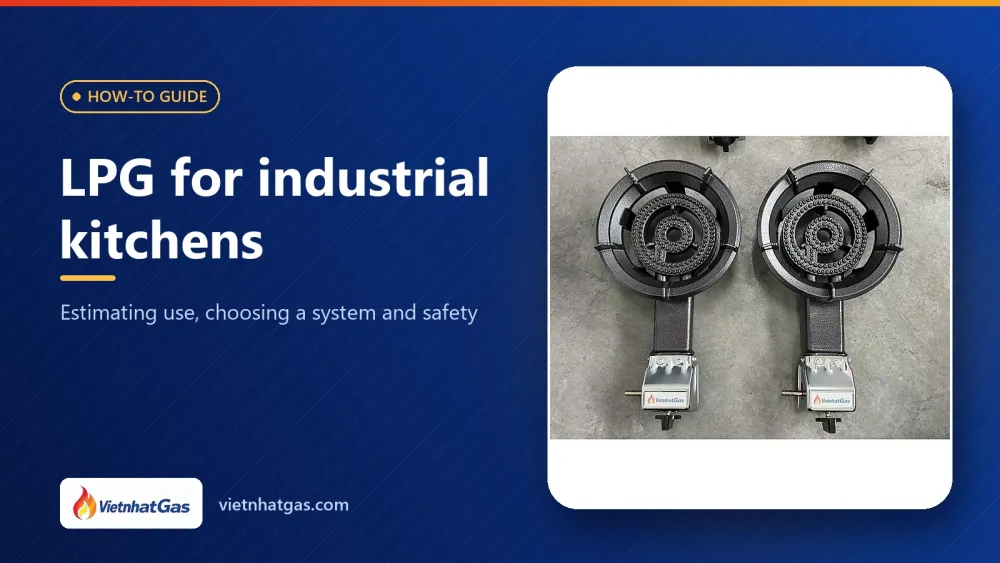
List the gas appliances: wok burners, stockpot burners, rice steaming cabinets... together with the hourly gas consumption shown on the label or documentation of each appliance.
Estimate the burning time of each appliance per day, based on the number of meals and the menu.
Multiply consumption by burning time and add them up to get the daily gas use, then multiply by the number of operating days in the month.
Compare with actual use: record the number of cylinders used in the first few weeks to fine-tune the estimate.
The calculation is similar to how long a 12kg gas cylinder lasts, only on a different scale. Also pay attention to the instantaneous flow rate at peak times when many burners run together.
45kg cylinder manifold or bulk tank system?
45kg cylinder manifold
Several 45kg cylinders connected via a common manifold, usually split into an in-use group and a standby group.
Lower initial investment, flexible, suitable for medium-sized kitchens.
Enough cylinders are needed for the gas to vaporise fast enough under continuous heavy burning, to avoid frosted cylinders and a weak flame.
Bulk tank system
Suitable for kitchens with very high consumption; gas is filled from a tanker into a fixed storage tank.
Must be designed, approved, licensed and installed by a qualified contractor in accordance with current regulations; the tank and pressure equipment must be inspected.
Greater investment and more procedures, in return for a stable supply.
Choose on the advice of a qualified gas system design contractor; for principles on laying out the cylinder area and piping, see restaurant gas cylinder installation.
Gas supply contract with a dealer
A scheduled delivery timetable and the response time for urgent deliveries.
Good ventilation and fume extraction; a well-ventilated cylinder area, separate from the cooking area.
Regular maintenance
Daily: check for a smell of gas and the condition of the burners before each cooking shift; close the valves after the shift.
Periodically: test the joints for leaks with soapy water, check hoses and regulators, and clean the burners — for high-output burners see restaurant wok burners.
Check and inspect the system according to the manufacturer’s recommendations and current regulations; keep a maintenance log.
Staff training
Kitchen staff need to know the order for opening and closing valves, how to recognise the smell of gas and what to do in the event of a leak: close the main valve, do not switch electrical devices on or off, ventilate, evacuate and call the fire service on 114 from a safe area. Training and drills should be held regularly in line with fire prevention and firefighting regulations.
When a canteen opts for a bank of 45kg cylinders, the people running it should understand the system they are using: our guide to gas cylinder manifolds, their components and safe operation covers the main parts, why a manifold is needed and how to work out a suitable number of cylinders.
In kitchens that cook continuously for hours, cylinders may sweat and then frost over; our article on why gas cylinders frost over and how to deal with it properly helps staff understand the frost line on the cylinder and avoid dangerous quick fixes.
Frequently asked questions
Should industrial kitchens use 12kg or 45kg LPG cylinders?
45kg cylinders or a 45kg cylinder manifold are more suitable: fewer changes are needed, and the gas vaporises better under heavy burning. 12kg cylinders only suit small kitchens.
Can a kitchen install a bulk gas tank system itself?
No. A bulk tank system must be designed, licensed and installed by a qualified contractor in accordance with current regulations.
How often should a kitchen’s gas system be checked?
A quick check every day before the cooking shift; detailed maintenance according to the recommendations of the equipment manufacturer, the installer and current regulations.
VietnhatGas supplies 45kg LPG cylinders, cast-iron wok burners and cylinder valves to dealers serving commercial kitchens. Send a request on our quotation page.
Written by the VietnhatGas technical and sales team — a batch manufacturer of LPG cylinders. This content is for reference; regulations and standards may change, so please check the current texts.
A restaurant wok burner gives a big flame for stir-frying, deep-frying and stewing. How to choose a burner by dish and output, choose the regulator and a suitable gas supply, install it, clean the burner head and stay safe.
A gas cylinder manifold connects several 45kg cylinders to a common header to supply gas continuously to large kitchens and workshops. Its main parts, why it is needed, how to work out the number of cylinders and safe operation.
A guide to restaurant gas cylinder installation for restaurants and commercial kitchens: 12kg or 45kg cylinders, where to place them, cylinder manifolds, regulators, piping, leak detectors and safe operating habits.
Read article →
Need a volume quote?
Send us the capacity, quantity and brand printing requirements — VietnhatGas will reply with a batch quotation.