Industrial vs household gas: how do they differ, and who should use which?
Industrial and household gas are both LPG. They differ in cylinder size, propane – butane ratio, regulator, installation requirements and the users they suit.
VietnhatGas · · 3 min read
When customers call a dealer, they are often asked whether they want “household gas” or “industrial gas”. It sounds like two different fuels, but in practice industrial vs household gas is not a choice between two gases: both are LPG, and the differences lie in the packaging, the equipment used with it, the installation requirements and the users. Understanding this helps you choose the right gas supply and avoid using the wrong equipment.
Both LPG, used differently
Both are liquefied petroleum gas, consisting mainly of propane and butane; both are heavier than air and have an odorant added — see what is LPG. “Industrial” and “household” describe the intended use, not two separate gases. Industrial gas serves high-consumption users such as restaurants, canteens and factories.
Quick comparison
Criterion
Household gas
Industrial gas
Common packaging
12kg cylinder
45kg cylinder, cylinder manifold, storage tank
Users
Households, small eateries
Restaurants, canteens, production facilities
Regulator
Low pressure, for household stoves
Depends on the equipment, usually a high-pressure regulator or a regulating system
Installation
The dealer fits the cylinder, regulator and hose
A qualified contractor designs, installs and leak tests the system
Procedures
Simple
Depending on the scale, fire safety requirements may have to be met
Packaging
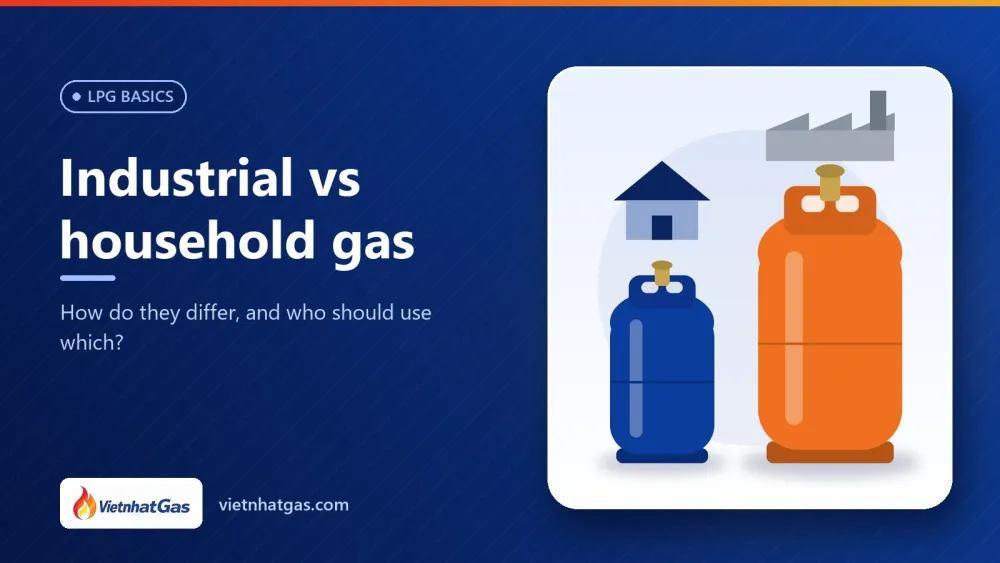
Household gas mainly comes in 12kg cylinders that one person can carry. Industrial gas usually comes in 45kg cylinders — a full cylinder weighs about 83 – 87kg — or is filled into fixed storage tanks for very large consumers. How dealers divide their orders between the two cylinder sizes is covered in 12kg vs 45kg LPG cylinders.
Is the propane – butane ratio different?
It may be, depending on the supplier and the time. Propane vaporises better at low temperatures, so a propane-rich mix gives a steadier vapour supply when large amounts of gas are drawn; some suppliers therefore adjust the ratio for industrial customers, but this is not a general rule — ask your supplier if your equipment requires a specific composition. For the properties of butane, see what is butane.
Regulators and associated equipment
This is the difference most likely to cause problems. Household stoves use low-pressure regulators; wok burners, dryers and industrial burners need higher flow and pressure, so they use a regulator or regulating system as instructed by the equipment manufacturer. Mixing them up can cause flare-ups or a weak flame — see gas regulator. On the cylinder side, you need a cylinder valve of the right type for the regulator in use.
Installation and safety requirements
For a 12kg cylinder, having the dealer fit the cylinder, regulator and hose to the stove is enough. An industrial gas system includes a separate cylinder area, a manifold, fixed pipework and emergency shut-off valves; it must be designed, installed, leak tested and accepted by a qualified contractor in accordance with current regulations — see gas for industrial kitchens. VietnhatGas manufactures cylinders and cylinder valves and does not install systems.
Can a household use a 45kg cylinder, or an eatery a 12kg cylinder?
A household using a 45kg cylinder: in terms of fuel it is possible, but the cylinder is very heavy, needs a well-ventilated spot outside the kitchen area and is hard to change, and many buildings do not allow it; the regulator must still be a low-pressure type. For most households, a 12kg cylinder makes sense.
An eatery using a 12kg cylinder: suitable for a small eatery with one or two burners. A large burner running continuously will need frequent cylinder changes, and the cylinder easily gets cold and the flame weak — see frozen gas cylinder. In that case, switch to a 45kg cylinder or a cylinder manifold.
Frequently asked questions
Does industrial gas burn more strongly than household gas?
Not significantly in terms of the fuel. Flame strength depends mainly on the burner, the regulator and the amount of gas supplied.
Is industrial gas cheaper than household gas?
There is no general answer; the price depends on the supplier, the delivery format, the contract and monthly price movements.
Should a small workshop use 12kg or 45kg cylinders?
It depends on consumption and equipment output. High-output equipment running for many hours should use 45kg cylinders or a cylinder manifold sized by a qualified contractor.
VietnhatGas manufactures 12kg gas cylinders, 45kg gas cylinders and cylinder valves in batches for dealers and filling stations serving both household and industrial customers. Send a request on our quotation page.
Written by the VietnhatGas technical and sales team — a batch manufacturer of LPG cylinders. This content is for reference; regulations and standards may change, so please check the current texts.
Gas cylinders in circulation must be re-inspected when they fall due. Who may carry this out, the technical basis, the usual inspection steps and how dealers should plan for it.
Practical tips on gas dealer customer retention: fast delivery, reminders before the gas runs out, free safety checks, transparent prices, loyalty schemes, looking after restaurants and keeping customer records.
Transporting gas cylinders safely: choosing the vehicle, keeping cylinders upright and firmly secured, closing the valve, handling with care, dealing with a leak on the road and what to watch when delivering to customers’ homes.
Read article →
Need a volume quote?
Send us the capacity, quantity and brand printing requirements — VietnhatGas will reply with a batch quotation.