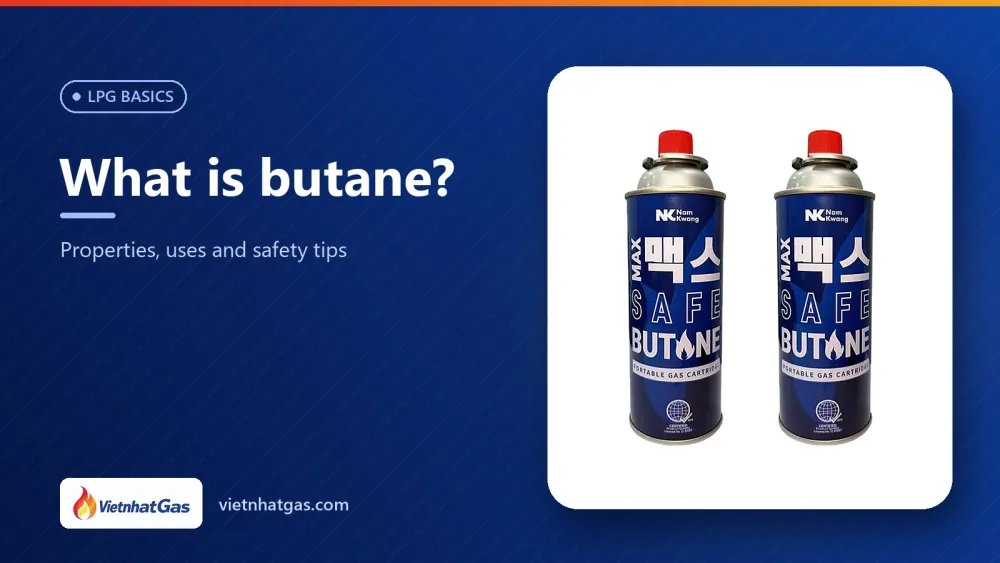
What is butane, what are its properties and how does it differ from propane? Learn why butane is used in mini gas canisters and lighters, why stoves give a weak flame in cold weather, and safety tips for using it.
VietnhatGas · · Updated · 4 min read
On mini gas canisters, lighters and aerosol cans you often see the word “butane”. So what is butane, why is it so widely used in everyday life and what should you bear in mind when using it? This article briefly explains the properties of butane, its common uses, how it differs from propane and the basic safety principles.
What is butane?
Butane is a hydrocarbon with the formula C₄H₁₀, belonging to the group of petroleum gases. Butane has two structural forms, n-butane and isobutane, with very similar properties. Together with propane, butane is a main component of liquefied petroleum gas — see what is LPG.
At normal temperature and pressure, butane is a colourless gas. Pure butane is almost odourless, which is why commercial gas fuels usually have an odorant added so that users can easily detect a leak — find out more in what gas smells like.
Key properties of butane
Liquefies at moderate pressure: butane turns liquid when compressed at a pressure that is not very high. This allows a large amount of fuel to be held in a small, thin-walled container such as a mini gas canister.
Vaporises poorly in the cold: n-butane boils at around 0°C. When the ambient temperature drops close to or below this level, butane struggles to vaporise, the pressure in the canister is low and the stove gives a weak flame.
Heavier than air: when it leaks, butane tends to sink and collect in low places such as floors, under cupboards and in hollows.
Flammable: a mixture of butane and air in certain proportions can ignite or cause a fire or explosion when it meets a spark.
Expands with heat: when a canister heats up, the pressure inside rises quickly — the reason gas canisters must not be kept near heat sources.
Gas cylinders (blended with butane), industrial uses
Because its vapour pressure is lower, butane suits thin-walled single-use canisters. Propane needs a container that withstands higher pressure, such as a steel gas cylinder.
What does “clean gas” mean?
The phrase “clean gas” on mini gas canisters usually refers to butane burning relatively cleanly: when burnt properly with enough air, the flame is blue, with little soot and less smoke than charcoal or firewood. This does not mean the gas is harmless. Burning without enough oxygen still produces dangerous CO, so always use stoves in a well-ventilated place.
Safety tips when using butane
Store gas canisters in a dry, cool, well-ventilated place, out of direct sunlight, and do not leave them in a hot car.
Do not heat, puncture or burn canisters, even when they are empty.
Butane is one component of LPG; to tell this group of gases apart from liquefied and compressed natural gas, see our comparison of LPG, LNG and CNG, which includes safety notes on whether each gas settles low down or rises.
Frequently asked questions
Is butane toxic?
Butane is not highly toxic at low concentrations, but inhaling high concentrations is very dangerous because it causes oxygen deprivation. The bigger risks are fire or explosion from a leak and CO when it burns without enough air.
Why do mini gas canisters give a weak flame in the cold season?
Butane vaporises poorly at low temperatures, the pressure in the canister drops and so the flame is weak. Let the canister return to room temperature naturally; do not warm it over a flame.
Do mini gas canisters contain propane?
It depends on the product. Some types have other components added to improve performance in the cold; check the information printed on the canister.
Understanding what butane is helps you use and store gas canisters correctly. VietnhatGas manufactures and supplies butane mini gas canisters to dealers, shops and OEM orders — see selling mini gas canisters. Send a request on our quotation page.
Written by the VietnhatGas technical and sales team — a batch manufacturer of LPG cylinders. This content is for reference; regulations and standards may change, so please check the current texts.
How to spot low-quality butane canisters by the label, batch code, can body, valve and price; why caution is needed and which documents dealers should request from their suppliers.
Where the production date, expiry date and batch code of a butane canister are printed, what the shelf life means for a pressurised canister, how to check a canister before use and what to do with expired ones.
Private-label (OEM) butane mini gas canisters: who they suit, what can be customised, mandatory label content, the ordering process, minimum quantities and paperwork.
Read article →
Need a volume quote?
Send us the capacity, quantity and brand printing requirements — VietnhatGas will reply with a batch quotation.