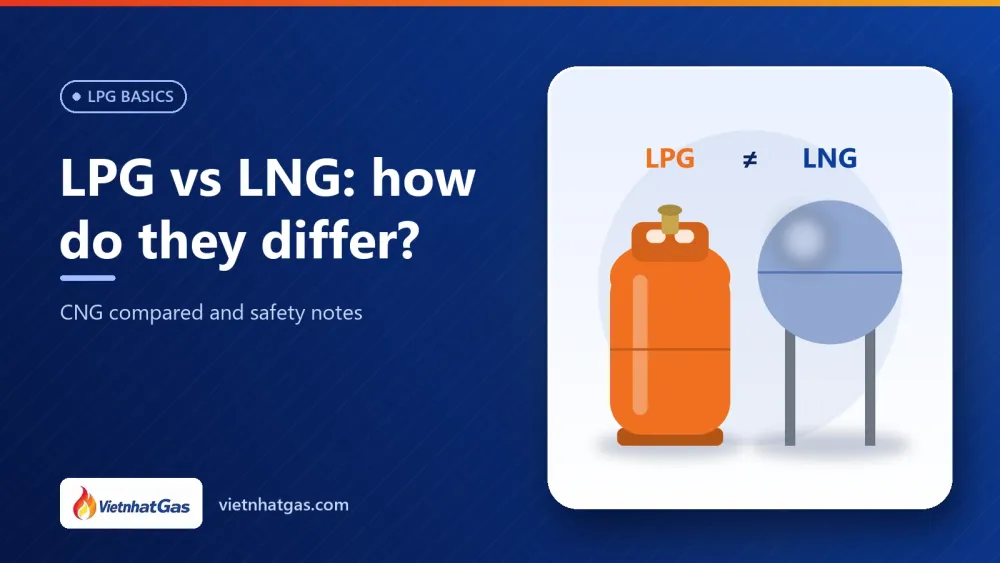
LPG vs LNG: how do they differ? CNG compared and safety notes
LPG, LNG and CNG compared by composition, liquefaction, storage, transport and typical users, plus the most important safety difference: whether the gas is heavier or lighter than air.
VietnhatGas · · 3 min read
The familiar “gas” in Vietnam is LPG in steel cylinders, but businesses are hearing more and more about LNG and CNG. Both are fuel gases, yet in the LPG vs LNG comparison they differ in composition, in how they are liquefied and stored, and in how a leak should be handled. Below is a brief comparison.
Three terms to tell apart
LPG (liquefied petroleum gas): mainly propane and butane — see what LPG is.
LNG (liquefied natural gas): mainly methane, deep-cooled to around −162°C to turn it into a liquid.
CNG (compressed natural gas): also natural gas, but in gaseous form, compressed to very high pressure.
Differences in liquefaction and storage
Propane and butane liquefy when compressed to a moderate pressure, even at ordinary temperatures. That is why LPG is held in steel cylinders such as 45kg cylinders, in fixed storage tanks or in mini gas canisters; for the gas in mini canisters, see what butane gas is.
Methane cannot be liquefied simply by compressing it at ordinary temperatures, so LNG has to be deep-cooled and then kept in dedicated insulated tanks; the portion that gradually boils off during storage must be recovered and handled. CNG stays a gas but is compressed to very high pressure, requiring containers that withstand high pressure.
Transport and typical users
LPG: carried by ship and road tanker to depots and filling stations, then distributed in cylinders to homes, restaurants and workshops; no pipeline is needed. Larger sites use storage tanks or a gas cylinder manifold; for the sectors that use the most, see industrial uses of LPG.
LNG: carried by dedicated ships to port terminals, regasified and then supplied by pipeline, or carried by insulated road tankers to large customers.
CNG: carried by vehicles fitted with banks of high-pressure cylinders to factories that have no gas pipeline.
LPG, LNG and CNG comparison table
Criterion
LPG
LNG
CNG
Main components
Propane, butane
Methane
Methane
State in storage
Liquid, compressed to moderate pressure at ordinary temperature
Liquid, deep-cooled to around −162°C
Gas, compressed to very high pressure
When it leaks
Heavier than air, collects in low places
Very cold vapour at first; once it warms up, lighter than air and rises
Lighter than air, rises
Typical users
Homes, restaurants, small and medium workshops
Power plants, industrial parks
Factories without a gas pipeline, vehicles
Differences in energy and burners
For the same volume of gas, LPG gives more heat than natural gas and needs a different amount of air to burn, so burners, nozzles and supply pressure are designed specifically for each type. Do not convert appliances to another gas yourself; any change of fuel must follow the appliance manufacturer’s instructions.
The most important safety difference
This is the LPG vs LNG difference that users most often get wrong. LPG is heavier than air: when it leaks, the gas collects on the floor, under cupboards and in drains, so the area where cylinders are kept needs ventilation at floor level and detectors mounted low down — see where to place a gas cylinder at home. Natural gas is lighter than air, rising and collecting under ceilings and roofs, so ventilation and detectors are placed high up; LNG also carries a risk of cold burns. A detector mounted in the wrong place will be slow to detect a leak — see gas leak detectors.
Whatever the gas, if you smell gas you must: not switch electrical equipment on or off, close the valve, ventilate the area, leave and call the fire service on 114 from a safe place.
Frequently asked questions
Can a household gas stove use LNG?
Not directly. Common household gas stoves are designed for LPG; natural gas needs a gas supply infrastructure and suitable burners.
Is LPG or LNG safer?
They cannot be compared in general terms. Both are safe when the system is designed, installed and inspected in line with regulations; the risks differ, so the precautions differ too.
Should a production workshop choose LPG or LNG?
It depends on consumption, location and access to supply. Small and medium sites usually choose LPG for its flexibility; very large consumers may consider LNG.
Understanding where LPG and LNG differ helps dealers give advice that matches their customers’ needs. VietnhatGas manufactures 12kg and 45kg LPG cylinders and butane mini gas canisters for dealers and businesses. Send a request on our quotation page.
Written by the VietnhatGas technical and sales team — a batch manufacturer of LPG cylinders. This content is for reference; regulations and standards may change, so please check the current texts.
How to promote a gas dealership at a reasonable cost: Google Maps, Zalo, Facebook, hotline stickers on cylinders, leaflets, partnerships with restaurants and apartment buildings, referrals, reviews and private-label cylinders.
What is LPG, how it is made up of propane and butane, why it is compressed into a liquid in steel cylinders, the properties to know for safe use and how LPG is used in homes, restaurants and industry.