What is a gas cylinder manifold? Components, cylinder count and safe operation
A gas cylinder manifold connects several 45kg cylinders to a common header to supply gas continuously to large kitchens and workshops. Its main parts, why it is needed, how to work out the number of cylinders and safe operation.
VietnhatGas · · 4 min read
A single 45kg cylinder is enough for a small eatery, but large restaurant kitchens, canteens and production workshops usually need several cylinders running at the same time. In that case, the cylinders are connected into a gas cylinder manifold to supply gas continuously at a sufficient flow rate. Below are its components, how to work out the number of cylinders and how to operate it safely.
What is a gas cylinder manifold?
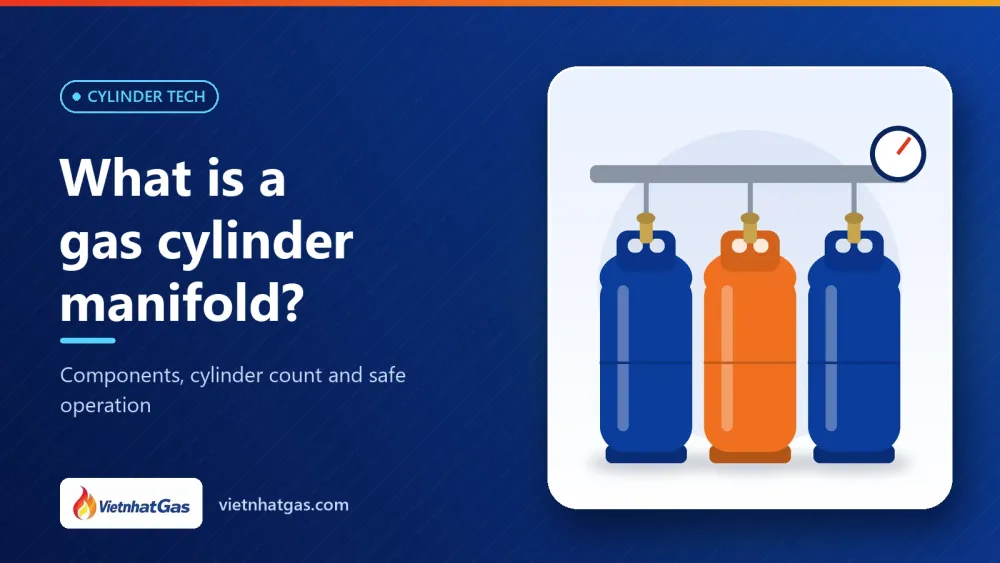
It is an assembly of several LPG cylinders, usually 45kg cylinders, connected to a common header and then through a regulator into the pipework leading to the burners. A manifold is usually split into two groups: an in-use group and a standby group. The articles installing gas cylinders in restaurants and gas for industrial kitchens only touched on this option.
Common components
Gas cylinders: 45kg cylinders with the same type of valve, standing upright, held by a rack or chain.
Flexible connecting hoses: connect each cylinder valve to the header; depending on the system, non-return valves allow a cylinder to be removed without gas escaping from the header.
A metal header that collects gas from the cylinders, together with branch isolation valves and a main valve to isolate each group or shut off the whole system.
Regulator, single- or two-stage, reducing the pressure to a level that suits the burners.
Pressure gauges to monitor the gas supply.
Automatic changeover device (depending on the system): switches automatically to the standby group when the pressure in the in-use group drops.
Why use a cylinder manifold?
Gas in the cylinder is liquid and must vaporise before it can be supplied to the stove; this process draws heat from the cylinder shell and its surroundings. Each cylinder can only deliver a limited amount of vapour; draw more than that and the pressure drops, the flame weakens, the cylinder gets cold and may frost over. Connecting several cylinders shares the load, providing enough vapour for peak hours. A manifold also allows a group of empty cylinders to be changed without turning off the stoves.
How to work out the number of cylinders
The exact figure is calculated by the designer; the general method is as follows:
List the burners, such as restaurant wok burners, and the gas consumption shown on the label of each appliance.
Determine the maximum flow rate when several appliances run at the same time during peak hours.
Estimate the vaporisation capacity of each cylinder under actual conditions, which depends on the ambient temperature, the amount of gas left and the duration of continuous draw.
Calculate the number of cylinders for the in-use group, adding a safety margin; the standby group is usually the same size.
Compare daily consumption with the gas delivery schedule to work out the number of reserve cylinders.
Siting, design and installation
The manifold is placed in a separate, well-ventilated area, away from the cooking area. LPG is heavier than air, so the cylinder area must be ventilated at floor level and must not be in a basement or a low-lying spot — a difference from natural gas, see LPG vs LNG: how do they differ. Safety distances, the amount of gas stored and fire protection equipment follow current regulations.
A cylinder manifold must be designed, installed, leak tested and commissioned by a qualified installer. VietnhatGas supplies 45kg cylinders and cylinder valves to distributing dealers and does not install systems.
Operation and periodic checks
Changing cylinders: close the branch valve and the valves of the empty cylinders, remove them, check the seals, fit full cylinders, open the valves slowly and test for leaks with soapy water, never with a flame.
Only accept cylinders within their inspection date, with the cylinder and valve intact — see periodic inspection.
Check hoses, valves and joints regularly; carry out maintenance according to the installer’s schedule.
If you smell gas: close the main valve, do not switch electrical equipment on or off, ventilate the area, leave and call the fire service on 114 from a safe place.
Frequently asked questions
What is the minimum number of cylinders for a gas cylinder manifold?
There is no general figure; the designer calculates it from the peak-hour flow rate and the actual vaporisation conditions.
Can 12kg cylinders be used in a cylinder manifold?
It depends on the design, but manifolds usually use 45kg cylinders because, for the same amount of gas, cylinders need changing less often and there are fewer joints.
Is an automatic changeover device mandatory?
No. It helps keep gas supplied continuously when nobody is monitoring the system; whether to fit one is up to the designer’s recommendation.
VietnhatGas supplies 45kg gas cylinders, cylinder valves and cast-iron gas wok burners to dealers serving restaurants and canteens. Send a request on our quotation page.
Written by the VietnhatGas technical and sales team — a batch manufacturer of LPG cylinders. This content is for reference; regulations and standards may change, so please check the current texts.
A guide to restaurant gas cylinder installation for restaurants and commercial kitchens: 12kg or 45kg cylinders, where to place them, cylinder manifolds, regulators, piping, leak detectors and safe operating habits.
LPG for industrial kitchens in factories, schools and hospitals: how to estimate gas use, 45kg cylinder manifolds or bulk tanks, contracts with dealers, safety equipment, maintenance and staff training.
A restaurant wok burner gives a big flame for stir-frying, deep-frying and stewing. How to choose a burner by dish and output, choose the regulator and a suitable gas supply, install it, clean the burner head and stay safe.
Read article →
Need a volume quote?
Send us the capacity, quantity and brand printing requirements — VietnhatGas will reply with a batch quotation.