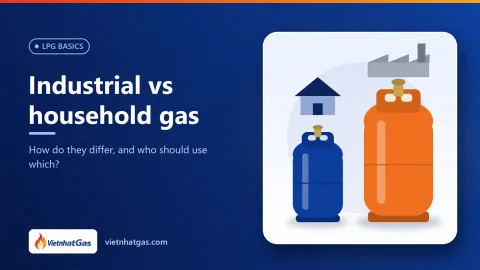
Industrial vs household gas: how do they differ, and who should use which?
Industrial and household gas are both LPG. They differ in cylinder size, propane – butane ratio, regulator, installation requirements and the users they suit.
Read articleAn overview of the industrial uses of LPG: drying farm produce, firing ceramics, process heating, metal cutting and brazing, forklifts, food processing and paint curing ovens; advantages, gas supply options and safety points.
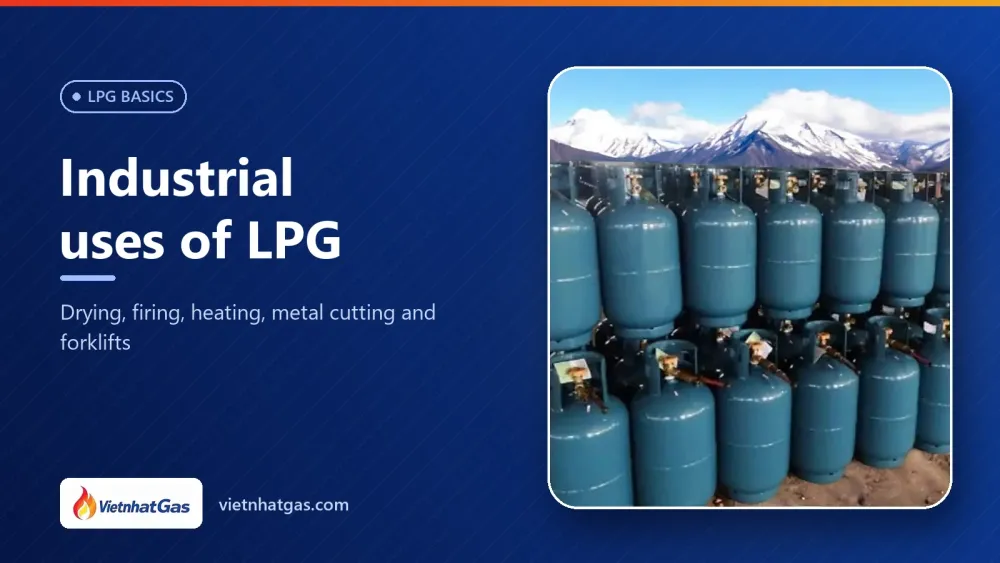
Liquefied petroleum gas is not only used for cooking; it is also a familiar heat source in factories. This article sums up the common industrial uses of LPG, its advantages, the gas supply options and the safety points that owners of production facilities need to know. If you are not yet clear on the concept, first read what is LPG.
Dryers use gas burners to dry coffee, cashew nuts, pepper, fruit and seafood. Heat from gas produces little smoke and odour; the temperature can be adjusted for each batch, helping products dry evenly.
Gas kilns allow the temperature to be raised, held and lowered according to a preset schedule — an important factor for glaze quality. Many pottery workshops have switched from coal-fired to gas kilns to cut smoke and dust and make each firing easier to control. Glass workshops also use gas burners for heating, bending and annealing.
LPG supplies heat to small boilers, hot-dip tanks, shrink-wrap machines, heat presses and heating systems for factories and livestock housing. Equipment reaches temperature quickly and can be switched off as soon as it is not needed.
Engineering workshops use gas with oxygen to cut steel plate and sections and to braze copper pipes and small parts. Cutting torches, flashback arrestors and hoses of the correct type designed for gas must be used.
LPG forklifts are common in warehouses because their exhaust is cleaner than that of diesel forklifts and cylinders can be changed quickly. Forklift cylinders are a specialised type designed to the forklift manufacturer’s specifications.
Baking ovens, industrial cooking pots and frying and roasting lines use gas because the flame is strong and clean. Canteens are also major gas users.
After powder is sprayed on, metal parts go into a curing oven so the coating melts and hardens; the oven uses gas burners that heat up quickly and hold a stable temperature. The LPG cylinder powder coating process also needs this curing stage.
Small to medium consumption is usually served by a manifold of 45kg cylinders, which needs low investment and is quick to set up; facilities with large, continuous consumption usually use a storage tank filled by tanker truck, which must be designed, approved, installed, inspected and accepted under current regulations by a properly qualified organisation. How to choose between the two, how to set up standby cylinder groups and how to stop cylinders frosting over are covered in gas for industrial kitchens; for the features of each cylinder size, see common types of gas cylinders.
When weighing up fuel options for a factory, businesses may also come across LNG or CNG; our article on the differences between LPG, LNG and CNG compares storage, transport, typical users and the safety points for each.
If you are weighing up a gas supply for a production facility, our article on how industrial and household gas differ compares cylinder formats, propane–butane ratios, regulators and installation requirements for each type.
If you need clean, easily adjustable heat, LPG is worth considering; costs should be calculated on each workshop’s actual consumption.
It depends on the quantity of gas stored and current regulations; ask the local fire prevention and fighting authority before installation.
No. VietnhatGas manufactures LPG cylinders and valves; system design and installation are carried out by qualified organisations.
Demand for gas in production opens up opportunities for dealers who understand the industrial uses of LPG. Need 45kg cylinders, cylinders in a range of capacities and gas cylinder valves for your production customers? Send a request on our quotation page.
Written by the VietnhatGas technical and sales team — a batch manufacturer of LPG cylinders. This content is for reference; regulations and standards may change, so please check the current texts.
Industrial and household gas are both LPG. They differ in cylinder size, propane – butane ratio, regulator, installation requirements and the users they suit.
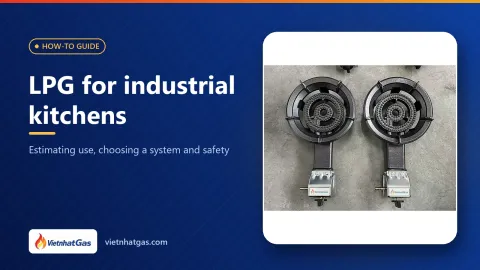
Read articleLPG for industrial kitchens in factories, schools and hospitals: how to estimate gas use, 45kg cylinder manifolds or bulk tanks, contracts with dealers, safety equipment, maintenance and staff training.
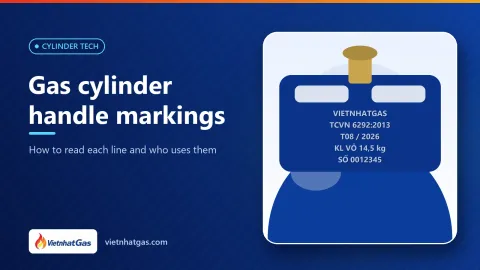
Read articleA guide to reading the lines stamped on the carry handle of a gas cylinder: owner, manufacturing standard, manufacturer, month and year of manufacture, tare weight, working pressure, serial number and what to do when the text is faded.
Read articleSend us the capacity, quantity and brand printing requirements — VietnhatGas will reply with a batch quotation.