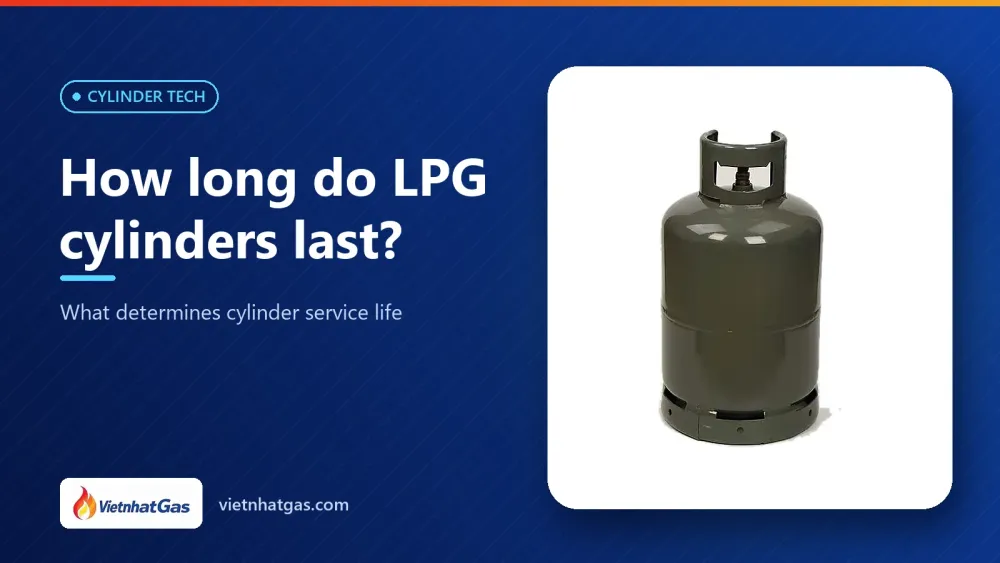
How long do LPG cylinders last? What determines cylinder service life
LPG cylinders have no fixed service life: a cylinder stays in use while it continues to pass periodic inspection. The factors that shorten and extend cylinder life, and how dealers can plan cylinder replacement.
VietnhatGas · · Updated · 4 min read
New dealers buying cylinders, filling plant owners and consumers have all asked: how long do LPG cylinders last? The short answer is that there is no fixed figure that applies to every cylinder. A cylinder stays in circulation while it continues to pass periodic inspections under current regulations, and is withdrawn when it no longer passes.
Periodic inspection determines service life
An LPG cylinder is pressure equipment and must be inspected before being put into use and re-inspected periodically under current regulations. At each inspection, an authorised body checks the condition of the cylinder, carries out a pressure test and checks the valve. Cylinders that pass have a new inspection date marked on the cylinder; cylinders that fail must be withdrawn.
A well-made, carefully maintained cylinder can pass many inspections; a poor-quality cylinder that has been knocked about or has rusted may be withdrawn early. For inspection dates and the accompanying documents, see LPG cylinder inspection records.
Factors that wear cylinders out quickly
Rust: cylinders stood on damp floors, left out in the rain, or with scratched paint exposing the steel; deep rust on the base, the foot ring and around the welds is a common reason for withdrawal.
Dents and deformation: dropped from vehicles, knocked during loading and unloading, stacked incorrectly.
Exposure to fire or high heat: cylinders with scorched paint or caught in a fire must be reassessed by an inspection body.
Poor storage and handling: laid down or kept near heat sources; throwing cylinders damages the foot ring, handle and valve.
Load and unload gently; do not roll, drag or throw cylinders.
Check the exterior each time a cylinder returns to the filling plant, and deal early with cylinders whose paint is peeling.
When a cylinder can no longer be used
Cylinders that fail inspection or have damage that cannot be remedied are withdrawn and may not be filled or circulated. Destroying cylinders, so that they can no longer be reused as gas containers, is carried out under current regulations. Do not sell withdrawn cylinders to establishments of unclear origin because of the risk of illegal reuse.
How should dealers plan cylinder replacement?
Manage by serial number: record the year of manufacture, inspection date and condition of each cylinder — see LPG cylinder management for dealers.
Track the withdrawal rate to forecast how many cylinders need to be added.
Replace gradually by batch, avoiding concentrating costs at one time.
Whether a cylinder stays in service or is withdrawn is decided through its inspections; our article on what periodic cylinder inspection involves explains who carries it out, the technical basis and the usual inspection steps.
Frequently asked questions
Is there an expiry date marked on an LPG cylinder?
Cylinders are usually stamped with the year of manufacture and the inspection date. The inspection date shows when the cylinder must be re-inspected, not when it must be scrapped; a cylinder that passes inspection has a new date updated.
Is an old cylinder that is still within its inspection date safe?
A cylinder that is within its inspection date and shows no signs of damage such as deep rust, dents, bulges or scorching may be used. If you notice anything unusual, tell your dealer.
Can an old cylinder be repainted and used again?
Repainting only restores the protective surface layer and does not replace inspection; a cylinder must pass inspection before it can be circulated.
In short, how long LPG cylinders last depends on their original quality, how they are used and the result of each inspection. VietnhatGas manufactures 12kg and 45kg LPG cylinders and other capacities in batches so dealers can add to and replace their stock. Send a request on our quotation page.
Written by the VietnhatGas technical and sales team — a batch manufacturer of LPG cylinders. This content is for reference; regulations and standards may change, so please check the current texts.
Retail LPG prices are usually adjusted every month, mainly in line with world CP prices, along with exchange rates, freight, distribution costs and taxes and fees. The difference between the gas price and the cylinder price, and how dealers announce new prices.
LPG cylinder prices differ between manufacturers because of capacity, steel, valve, painting and brand printing, batch size, inspection documents and transport. How to compare quotes properly.
A guide to reading the lines stamped on the carry handle of a gas cylinder: owner, manufacturing standard, manufacturer, month and year of manufacture, tare weight, working pressure, serial number and what to do when the text is faded.
Read article →
Need a volume quote?
Send us the capacity, quantity and brand printing requirements — VietnhatGas will reply with a batch quotation.