Gas cylinder handle markings: how to read each line and who uses them
A guide to reading the lines stamped on the carry handle of a gas cylinder: owner, manufacturing standard, manufacturer, month and year of manufacture, tare weight, working pressure, serial number and what to do when the text is faded.
VietnhatGas · · 4 min read
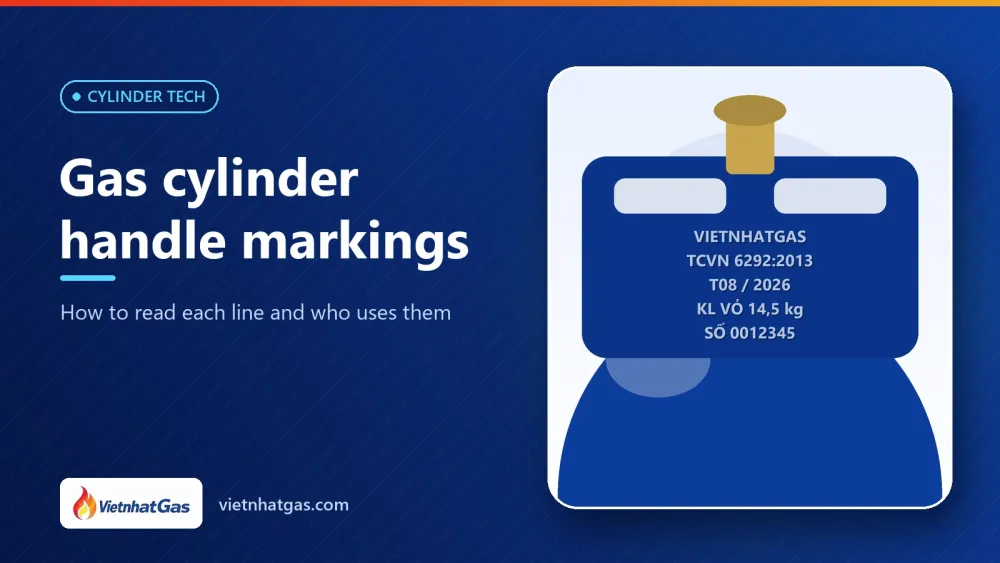
Every gas cylinder has a few lines of letters and numbers stamped into the steel of its carry handle. Being able to read the gas cylinder handle markings tells users who the cylinder belongs to and how much the empty cylinder weighs; dealers, filling stations and inspectors also rely on them to do their own jobs properly.
Why is the information stamped on the handle?
The mandatory information for a cylinder — the owner’s name, manufacturing standard, manufacturer, month and year of manufacture, tare weight and working pressure — is stamped on the carry handle (collar) together with the serial number. The handle is not a pressure-bearing part, so stamping it does not affect the cylinder body; stamped characters remain legible when the paint has aged and are harder to erase than a stick-on label.
What each line means
Owner’s name
This is the gas trader that owns the cylinder, not necessarily the manufacturer; it shows which network the cylinder belongs to and where it should be exchanged or returned. Under current regulations, cylinders belonging to another trader must not be filled without lawful consent — see should you buy used gas cylinders.
Manufacturing standard
The number of the standard to which the cylinder was made; for VietnhatGas cylinders this is TCVN 6292:2013, with reference to ISO 22991. It is the technical basis for inspecting the cylinder.
Manufacturer, month and year of manufacture
These show who made the cylinder and when its service life began. If a batch has a problem, this is the starting point for tracing it back to the production records; dealers use this date to know how long the cylinder has been in circulation.
Tare weight
The weight of the empty cylinder: a 12kg cylinder is usually about 13.5 – 15kg and a 45kg cylinder about 38 – 42kg depending on the model, so always use the figure on that particular cylinder. Subtract the tare weight from the weight shown on the scale to get the actual amount of gas — the steps are in how to check a gas cylinder’s weight.
Working pressure
The pressure the cylinder is designed to withstand in normal use. This is a specification of the cylinder, not the pressure of the gas going to the stove — that is determined by the regulator. Whether a cylinder passes or not is confirmed by pressure testing and inspection.
Serial number
Each cylinder’s unique code, linking it to its production batch and its inspections. How serial numbers work together with batch codes and QR labels is explained in LPG cylinder traceability.
Who reads which line?
Reader
Lines to check
Purpose
User
Owner, tare weight
Make sure you receive a cylinder of the brand you are buying; weigh it yourself if you suspect it is short of gas
Dealer
Owner, serial number, year of manufacture
Collect the right cylinders, manage them by serial number, keep track of inspection due dates
Filling station
Owner, tare weight, inspection mark
Fill only permitted cylinders, fill to the correct weight, reject overdue cylinders
Inspection body
All of them
Check against the records, weigh the cylinder, record the results
Periodic inspection mark
Cylinders in circulation also carry a mark showing the result and date of their periodic inspection; its form and position follow the regulations and the applicable standard. Users only need to remember that the cylinder must be within its inspection date — details in periodic inspection of gas cylinders.
What if the text is faded or shows signs of alteration?
Faded by paint or dirt: wipe it clean and look at it at an angle under the light; if you still cannot read it, ask the dealer to read it for you or exchange the cylinder.
Ground off, chiselled or overstamped, with the serial number missing: do not accept the cylinder; tell the dealer or call the brand’s hotline printed on the label.
Handle shows signs of re-welding or replacement: the dealer should set the cylinder aside and send it for inspection and assessment; do not restamp or alter the numbers yourself.
Why do two 12kg cylinders of the same type show different tare weights?
Because steel thickness, specifications and valves differ from model to model.
Do the gas cylinder handle markings change after each inspection?
The lines stamped during manufacture stay the same; inspection only adds a mark showing the result and the next due date, as required by regulations.
Do users need to understand every line on the handle?
No. You only need to see the brand you are buying, legible text and a cylinder that is within its inspection date.
VietnhatGas manufactures 12kg gas cylinders, 45kg cylinders and other capacities to TCVN 6292:2013, with all mandatory information and the serial number stamped on the handle. Send a request on our quotation page.
Written by the VietnhatGas technical and sales team — a batch manufacturer of LPG cylinders. This content is for reference; regulations and standards may change, so please check the current texts.
What businesses importing or contract-manufacturing LPG cylinders from Vietnam need to prepare: destination-market standards, certification, labelling, valve type, export documents, packaging and shipping.
LPG cylinders have no fixed service life: a cylinder stays in use while it continues to pass periodic inspection. The factors that shorten and extend cylinder life, and how dealers can plan cylinder replacement.
How to tell common types of gas cylinders apart: household cylinders of around 12kg, 45kg industrial cylinders, small specialised cylinders and mini butane canisters; steel or composite, valve types and how to choose for your needs.
Read article →
Need a volume quote?
Send us the capacity, quantity and brand printing requirements — VietnhatGas will reply with a batch quotation.