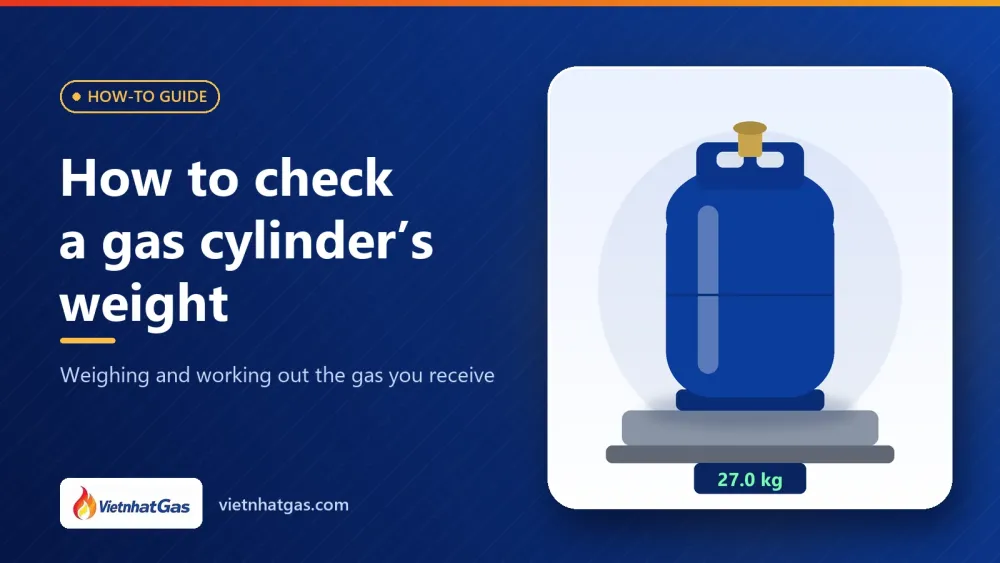
How to check a gas cylinder’s weight: weighing and working out the gas you receive
How to check a gas cylinder’s weight: read the tare weight stamped on the carry handle, choose a suitable scale, work out the actual gas, compare it with the nominal quantity and know what to do if the cylinder is short.
VietnhatGas · · 4 min read
When you buy a 12kg gas cylinder, you are paying for the 12kg of gas inside, but nobody can see through a steel cylinder. The most reliable way to check a gas cylinder’s weight is to weigh it and do a simple subtraction.
What does a “full-weight” cylinder mean?
The figure 12kg or 45kg is the nominal quantity of gas, excluding the cylinder itself. “Full weight” means that the weighed mass minus the tare weight equals the nominal quantity, within the permitted tolerance. At filling plants, cylinders are filled by weight and check-weighed afterwards — see the gas filling process.
Step 1: Read the tare weight on the carry handle
The mandatory information for a cylinder — the owner’s name, manufacturing standard, manufacturer, month and year of manufacture, tare weight and working pressure — is stamped on the carry handle together with the serial number.
An empty 12kg cylinder typically weighs about 13.5 – 15kg and an empty 45kg cylinder about 38 – 42kg, depending on the model. So you must use the figure on the cylinder you actually receive, not a general figure.
If the markings on the handle are faded, worn or painted over: ask the dealer to read them for you or exchange the cylinder. For the other markings, see LPG cylinder traceability.
Step 2: Weigh the cylinder on a suitable scale
Enough capacity: a full 45kg cylinder weighs about 83 – 87kg, so you need a platform scale or a floor scale.
Fine enough divisions: scales with large increments or household bathroom scales only give an approximate result.
Weigh it properly: the cylinder stands upright in the middle of the platform, with no hand resting on it and the regulator removed.
Step 3: Work out the actual gas in the cylinder
Formula: actual gas = weighed mass − tare weight marked on the handle.
Illustrative example: a 12kg cylinder weighs 26.4kg and the handle shows a tare weight of 14.3kg, so the actual gas is about 12.1kg — effectively full. If it weighs only 24.8kg, the actual gas is about 10.5kg, which is clearly short.
Understanding scale error
Every scale has some error, so a small difference on a household scale is not enough to conclude that a cylinder is underfilled; permitted tolerances follow current metrology regulations. Only large differences that recur across several cylinders are worth raising — in that case, reweigh the cylinder on the dealer’s trade scale with both parties present.
Ask the dealer to weigh the cylinder on delivery
The best time to check a gas cylinder’s weight is at the moment you receive it: check that the seal on the valve is intact, ask for it to be weighed on the spot and read the tare weight together. Restaurants that use many cylinders should record the weighing result each time they take delivery. For how to recognise a trustworthy dealer, see how to choose a reliable gas dealer.
Signs of an underfilled cylinder and the role of the seal
The cylinder runs out noticeably sooner than your household’s usual cycle — how to estimate the cycle is explained in how long a 12kg gas cylinder lasts.
An unfamiliar seal, no brand label, an unusually low price.
The seal shows that the cylinder has not been opened since it left the filling plant. A cylinder without its seal may have been decanted illegally, is more likely to be short of gas and has not been checked as it would be at a plant that meets the required conditions — do not accept it. A cylinder that runs out quickly may also be leaking; see how to check for gas leaks at home before drawing conclusions.
What should you do if a cylinder is underfilled?
Do not release gas yourself, and do not decant gas from one cylinder to another.
Inform the dealer, with the weighing result and photos of the handle and the seal; ask for it to be reweighed and the cylinder exchanged.
If the dealer does not resolve it: contact the brand hotline printed on the cylinder label, or report it to the regulatory authorities or a local consumer protection organisation in line with current regulations.
Frequently asked questions
Can I weigh a gas cylinder while it is connected to the stove?
Close the valve and remove the regulator before weighing, so that the hose does not take some of the weight — for how to do this, see how to change a gas cylinder at home.
Can I check a 45kg cylinder myself at home?
It is difficult, because you need a floor scale and two people to lift it; it is best to ask the dealer to weigh it on delivery.
Is the tare weight marked on the handle still accurate after many years?
Rust, repainting or a valve replacement can make the actual tare weight differ slightly, so weighing at home is mainly for spotting clear differences; in a dispute, reweigh the cylinder on the dealer’s scale.
VietnhatGas manufactures 12kg LPG cylinders and 45kg LPG cylinders with the tare weight and serial number clearly stamped on the carry handle, making filling by weight and checking easy. Send a request on our quotation page.
Written by the VietnhatGas technical and sales team — a batch manufacturer of LPG cylinders. This content is for reference; regulations and standards may change, so please check the current texts.
Gas cylinders in circulation must be re-inspected when they fall due. Who may carry this out, the technical basis, the usual inspection steps and how dealers should plan for it.
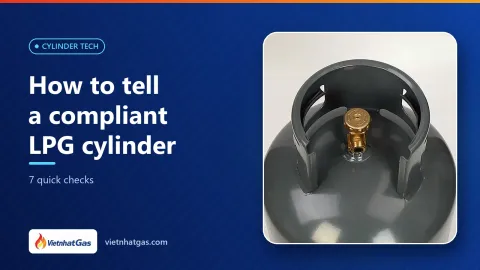
Seven checks for dealers and users to spot a compliant LPG cylinder: stamped data, welds, body, paint, valve, tare weight and the records that come with it.
How to choose a reliable gas dealer for your home or restaurant: a clear address and brand, licences, cylinders still sealed and within their inspection date, weighing on delivery, transparent prices and warning signs to avoid.
Read article →
Need a volume quote?
Send us the capacity, quantity and brand printing requirements — VietnhatGas will reply with a batch quotation.