Home gas delivery: dealer tips from taking the order to fitting the cylinder
Home gas delivery tips for dealers: committing to time slots, taking orders by phone and Zalo, professional staff, fitting the cylinder and testing for leaks at the customer’s home, safety on the road and handling complaints.
VietnhatGas · · 4 min read
For many households and food stalls, making a phone call and waiting for the gas cylinder to arrive right in the kitchen has become a habit. A home gas delivery service is therefore the face of the dealership: deliver quickly and fit carefully, and customers call again; deliver late and work carelessly, and customers switch dealers. This article brings together practical tips from taking the order through to fitting the cylinder and handling complaints.
Commit to clear delivery times
Customers usually call for gas because the cylinder has just run out in the middle of cooking, so what they care about most is how long it will take. Dealers should:
Publish daily delivery time slots that match the number of staff actually available.
Give an estimated delivery time as soon as the order is taken and call back if running late.
Divide the delivery area into routes so that one trip serves several orders close together.
Give priority to customers in the middle of cooking and food outlets during trading hours.
Taking orders by phone and Zalo
Use one fixed, easy-to-remember hotline number, plus Zalo so customers can send messages and share their location.
Record full details: name, phone number, address, cylinder type, gas brand and the type of valve in use.
Save the details in a notebook or software so that next time you only need to confirm them.
Delivery staff: uniform, name badge, skills
Customers are letting a stranger into their kitchen, so professionalism builds trust. Staff should wear a uniform bearing the dealership’s name, wear a staff badge, carry tools and soapy water for leak testing, and be trained in the cylinder-fitting procedure, recognising leaks and dealing with emergencies; safety training is carried out in accordance with current regulations.
Procedure at the customer’s home
Check the cylinder before carrying it in: the seal on the valve is intact, the inspection date on the cylinder is still valid, and the cylinder has no deep dents or heavy rust.
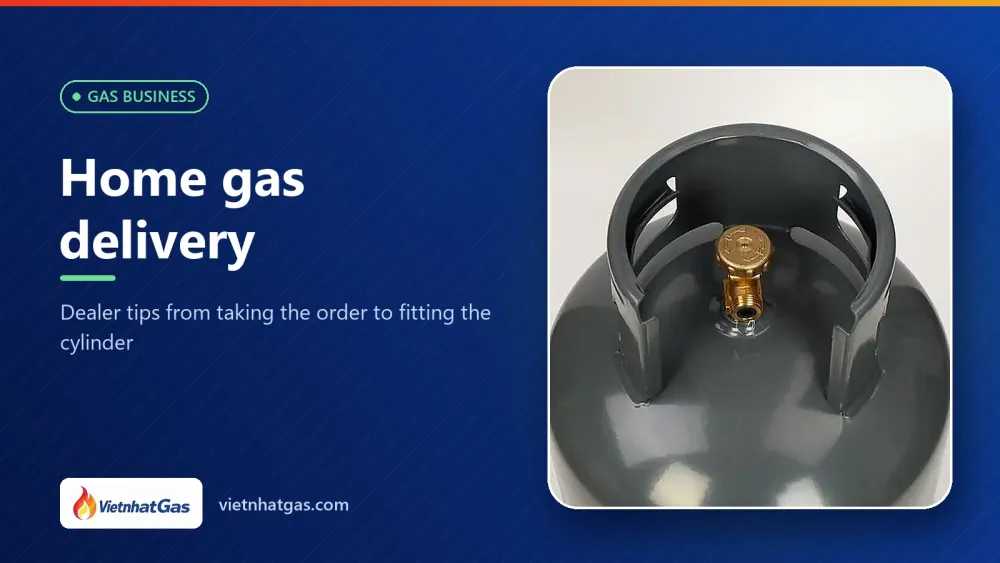
Close the valve, remove the old cylinder and fit the new one: use a regulator of the right type for the cylinder valve and tighten it just enough — follow the steps in how to change a gas cylinder at home.
Test for leaks with soapy water around the cylinder valve, the regulator and the hose ends; never test with a flame. If bubbles appear, close the valve and redo the connection — see how to check for gas leaks at home.
Light the stove to test it and check that the flame is blue and burns evenly.
Look over the hose and regulator: if the hose is cracked or hardened, or the regulator is old, advise the customer to replace it — see when to replace a gas hose.
Record the serial number of the cylinder just delivered in the customer’s file, as a basis for LPG cylinder traceability when needed.
Payment: collect exactly the price quoted, and provide a delivery note or invoice when the customer asks.
Safety on the delivery route
Cylinders are carried upright, firmly secured, with the valve protected.
Do not exceed the vehicle’s permitted load; do not keep cylinders near a heat source.
When loading and unloading, do not drop or throw cylinders onto the ground.
The customer reports a smell of gas: give instructions over the phone straight away — close the cylinder valve, do not switch electrical devices on or off, open doors for ventilation and leave the area; if it is serious, call the fire service on 114 from outside. Then send staff to inspect.
The customer suspects the cylinder is underfilled: weigh the cylinder in front of the customer and compare it with the tare weight marked on the cylinder.
Late delivery, impolite staff: apologise, take note and put it right.
A complaint handled with care is often more effective at keeping customers than any promotion.
Complaints about underfilled cylinders are easier to settle when delivery staff know how to weigh a cylinder in front of the customer; our guide to checking whether a gas cylinder is full weight explains how to read the tare weight and compare the actual gas with the nominal amount.
Frequently asked questions
What is a reasonable time for home gas delivery?
There is no single figure; it depends on distance, the number of staff and peak hours. What matters is giving an accurate estimated time and keeping your promise to the customer.
Should delivery staff check the customer’s hose?
Yes. A quick look at the hose and regulator takes only a few minutes but helps spot leak risks early; if a replacement is needed, explain clearly so the customer can decide for themselves.
Why record the cylinder serial number on delivery?
The serial number shows which cylinder is at which customer’s home, helping the dealer manage cylinders, track inspection dates and respond quickly when a customer raises an issue.
VietnhatGas supplies 12kg and 45kg LPG cylinders and cylinder valves to gas dealers. Send a request on our quotation page.
Written by the VietnhatGas technical and sales team — a batch manufacturer of LPG cylinders. This content is for reference; regulations and standards may change, so please check the current texts.
Transporting gas cylinders safely: choosing the vehicle, keeping cylinders upright and firmly secured, closing the valve, handling with care, dealing with a leak on the road and what to watch when delivering to customers’ homes.
How to calculate how many cylinders a gas dealer needs: cylinders at customers’ homes, cylinders in circulation, full-cylinder stock and a reserve; a worked example, the 12kg – 45kg mix, allowing for growth and signs of a shortage.
How to choose a reliable gas dealer for your home or restaurant: a clear address and brand, licences, cylinders still sealed and within their inspection date, weighing on delivery, transparent prices and warning signs to avoid.
Read article →
Need a volume quote?
Send us the capacity, quantity and brand printing requirements — VietnhatGas will reply with a batch quotation.