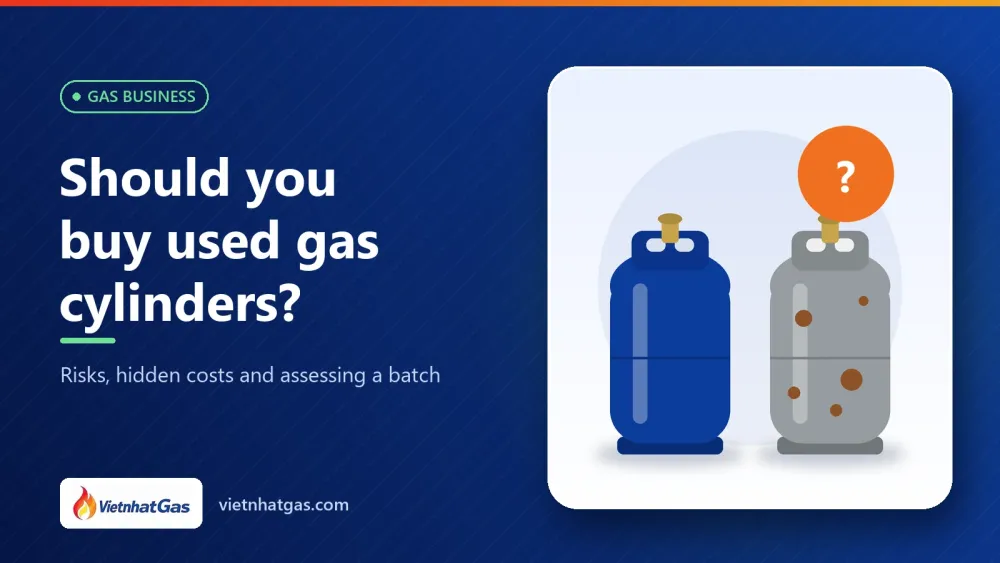
Should you buy used gas cylinders? Risks, hidden costs and assessing a batch
Should dealers buy second-hand gas cylinders? An analysis of the risks, hidden costs, ownership documents required, when new cylinders make more sense and how to assess a batch of used cylinders.
VietnhatGas · · 3 min read
When they need more cylinders for rotation, many dealers are offered used gas cylinders at prices well below those of new ones. But the purchase price is only part of the equation. This article takes a fair look at the risks, the hidden costs, the paperwork required and the cases where buying new cylinders makes more sense.
Why are second-hand cylinders attractive?
Second-hand cylinders are available in quantity, can be delivered quickly and cost little to acquire — especially when a trader closes down and sells off a whole batch. If the batch has a clear origin, valid transfer documents and still passes inspection, it may be an option worth considering. The problem is that not every batch is like that.
Risks to know in advance
Unknown history: the cylinders may have been left out in rain and sun, knocked, scorched or repaired incorrectly, with a fresh coat of paint hiding it all.
Overdue or nearly due for inspection: they must be re-inspected before they can be filled.
Cylinders owned by another trader: the owner’s name is stamped on the collar. Under current regulations on gas trading, traders must not use or fill cylinders owned by another trader without lawful consent.
Cylinders that have been rejected but not destroyed, and have been slipped onto the market — the most serious safety risk.
The hidden costs of a batch of used cylinders
Collecting the cylinders and transporting them to the warehouse.
Having the whole batch inspected at an inspection body.
Replacing valves, caps and seals on cylinders with damaged valves.
Cylinders that fail must be destroyed, and the money paid for them is lost entirely.
The right way to calculate is to divide the total cost of the batch by the number of cylinders that actually pass and go into circulation, and only then compare it with the price of new cylinders. In addition, the cylinders have already been through part of their service life, so their remaining life is hard to predict — see how long do LPG cylinders last.
Ownership documents required
A sales contract and invoice stating the quantity and capacity.
A list of serial numbers matching the data stamped on the collars.
Documents proving that the seller is the lawful owner.
The latest inspection results, if available; a handover record noting the condition of the cylinders.
Without documents proving ownership, do not buy, however low the price.
If you are still considering buying used gas cylinders
Verify the seller: legal status, the reason for the sell-off and ownership of the batch.
Randomly cross-check serial numbers and the data on the collars against the list.
Visually inspect a large enough sample; if the proportion of damaged cylinders is high, reconsider the purchase.
Agree to put the whole batch through periodic inspection before putting it into circulation, and pay according to the number of cylinders that pass.
State clearly in the contract how failed cylinders will be handled.
Frequently asked questions
Can cylinders still within their inspection date be put into use straight away?
Yes, if the dealer is the lawful owner, the paperwork is complete and the cylinders are undamaged.
Should you buy cylinders bearing another company’s name and repaint them?
You should not do this yourself. Ownership data stamped on the collar cannot be replaced by a coat of paint; transferring ownership and changing the information on the cylinder must follow current regulations.
Are second-hand cylinders really cheaper than new ones?
The purchase price is usually lower, but once inspection, painting, valve replacement and rejected cylinders are added, the gap can narrow considerably.
VietnhatGas manufactures new gas cylinders in a range of capacities in batches, with complete records and serial numbers, and offers private-label printing for dealers. Send a request on our quotation page.
Written by the VietnhatGas technical and sales team — a batch manufacturer of LPG cylinders. This content is for reference; regulations and standards may change, so please check the current texts.
The process for ordering LPG cylinders in batches from the manufacturer: request, technical consultation, quotation, sample approval, contract, production, quality control, packing, delivery and after-sales.
Retail LPG prices are usually adjusted every month, mainly in line with world CP prices, along with exchange rates, freight, distribution costs and taxes and fees. The difference between the gas price and the cylinder price, and how dealers announce new prices.
LPG cylinder prices differ between manufacturers because of capacity, steel, valve, painting and brand printing, batch size, inspection documents and transport. How to compare quotes properly.
Read article →
Need a volume quote?
Send us the capacity, quantity and brand printing requirements — VietnhatGas will reply with a batch quotation.