Common types of gas cylinders: capacity, material, valve type and how to choose
How to tell common types of gas cylinders apart: household cylinders of around 12kg, 45kg industrial cylinders, small specialised cylinders and mini butane canisters; steel or composite, valve types and how to choose for your needs.
VietnhatGas · · Updated · 3 min read
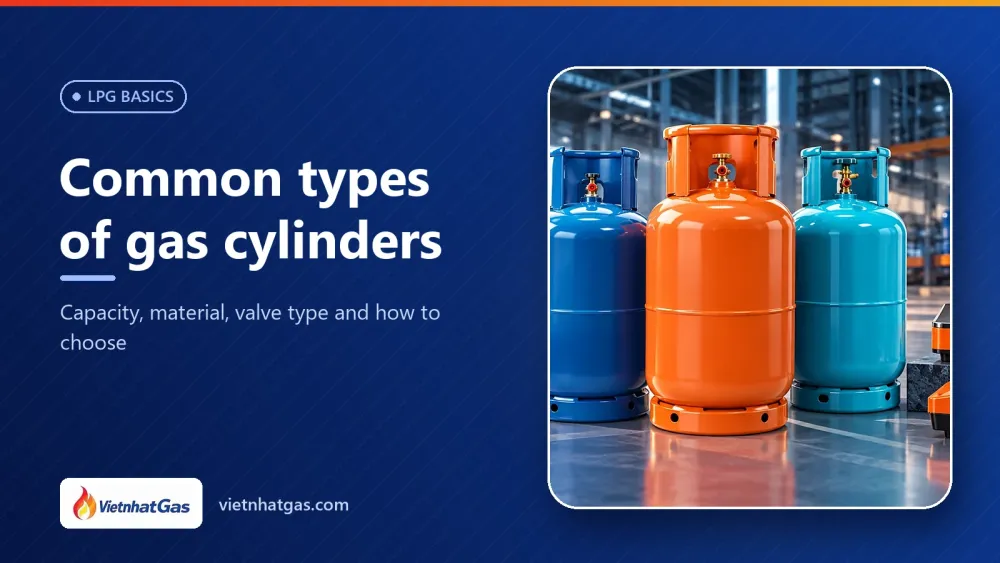
At a gas shop, customers come across many cylinder sizes, paint colours and valve types. Understanding the types of gas cylinders helps households choose a cylinder that matches their needs, helps food stalls and restaurants avoid running out of gas at peak times, and helps dealers stock the right product mix. This article classifies cylinders by capacity, shell material and valve type.
Classification by capacity
The figure marked on a cylinder, such as 12kg or 45kg, is the weight of gas filled, not the weight of the empty cylinder. The following groups are common on the market.
Household cylinders of around 12kg
This is the most popular size for home kitchens and small eateries: compact enough to deliver to the door and place in the kitchen (if kept in a cabinet, the cabinet must have ventilation openings near the floor). Some brands use roughly equivalent sizes, with small differences in the weight of gas filled. See 12kg LPG cylinder.
Industrial cylinders of around 45kg
Used by restaurants, canteens and production workshops, or connected into a cylinder manifold. A large cylinder means fewer changes, and the gas vaporises more steadily when burning at high output. Some markets and brands also use other large cylinder sizes. See 45kg LPG cylinder.
Small specialised cylinders
Besides the two main sizes, there are small cylinders for specific needs such as portable stoves, mobile food carts or camping; capacity and valve type vary by manufacturer. If you need a particular size, it can be made to order — see LPG cylinders in a range of capacities.
Mini butane gas canisters
Metal canisters pre-filled with butane for mini gas stoves; the most common size is 220–250g, and there is also a compact 120g size that is easy to carry. See 220–250g mini butane gas canisters. Mini gas canisters are single-use and must never be refilled yourself.
Classification by shell material
Steel shells: the most common, made from specialised steel plate, welded and coated; durable, impact resistant and suited to many years in rotation. VietnhatGas cylinders are manufactured to TCVN 6292:2013, with reference to ISO 22991.
Composite shells: lighter and rust-free, and some types let you see the gas level inside; usually more expensive, with their own inspection and storage requirements.
POL valve: left-hand thread inside the valve outlet; the regulator connector screws in; hex-nut connectors need a spanner and are usually fitted by dealer staff, while hand-wheel connectors are tightened by hand only.
QCC valve: large external thread; the connector has a handwheel and is fitted by hand without tools.
Clip-on valve: the regulator fits with a snap-on coupling for quick operation; used by some brands.
Besides capacity, choose the valve type that matches the regulator you use, and prefer cylinders of clear origin, within their inspection date and without deep rust or dents. A cylinder’s service life depends on manufacturing quality and inspection results — see how long do LPG cylinders last.
For dealers, the mix of types of gas cylinders should be based on your customer base: residential areas need more household cylinders, while areas with eateries and factories need more industrial cylinders — see 12kg vs 45kg LPG cylinders: which should a dealer stock.
Frequently asked questions
Can 12kg and 45kg gas cylinders share the same regulator?
Do not assume they can. The regulator must match the cylinder valve type and suit the stove’s flow rate; industrial stoves use their own regulators as instructed by the stove manufacturer.
Can mini gas canisters be refilled?
No. Mini butane canisters are single-use; refilling them yourself can cause leaks, fire or explosion. Empty canisters should be left to cool and collected separately, and never burnt or punctured.
Are composite gas cylinders better than steel ones?
Each has its own pros and cons: composite is light and rust-free but more expensive; steel is durable, widespread and suited to existing filling systems.
VietnhatGas manufactures 12kg and 45kg steel LPG cylinders and custom capacities to order for dealers, filling plants and businesses. Send a request on our quotation page.
Written by the VietnhatGas technical and sales team — a batch manufacturer of LPG cylinders. This content is for reference; regulations and standards may change, so please check the current texts.
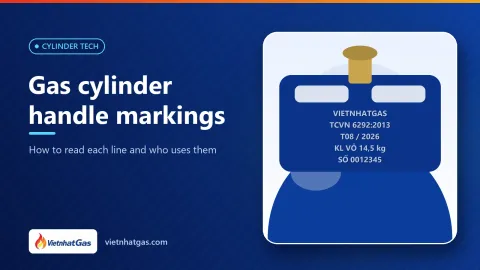
A guide to reading the lines stamped on the carry handle of a gas cylinder: owner, manufacturing standard, manufacturer, month and year of manufacture, tare weight, working pressure, serial number and what to do when the text is faded.
LPG cylinders have no fixed service life: a cylinder stays in use while it continues to pass periodic inspection. The factors that shorten and extend cylinder life, and how dealers can plan cylinder replacement.
Is a rusty gas cylinder, or one that is dented, scorched or bulging, safe? How to tell surface rust from serious damage, what users should do and how dealers deal with damaged cylinders.
Read article →
Need a volume quote?
Send us the capacity, quantity and brand printing requirements — VietnhatGas will reply with a batch quotation.