LPG cylinder welding: the welds, common defects and how they are inspected
LPG cylinder welding covers the longitudinal body seam, circumferential seams and the neck weld. Learn about automatic welding, common weld defects and inspection by ultrasonic testing, X-ray and pressure testing.
VietnhatGas · · Updated · 3 min read
A steel gas cylinder is made of several parts joined by welds. Welds are where stress concentrates and defects are most likely to occur, so LPG cylinder welding and weld inspection are key stages that decide whether a cylinder is safe under pressure. This article introduces the welds on a cylinder, the welding technology, common defects and how welds are inspected.
What welds does a gas cylinder have?
Longitudinal body seam: found on three-piece designs, where the cylinder body is rolled from steel sheet and then welded closed along its length.
Circumferential seams: joining the top and bottom heads to the body (or joining the two halves of the cylinder in a two-piece design).
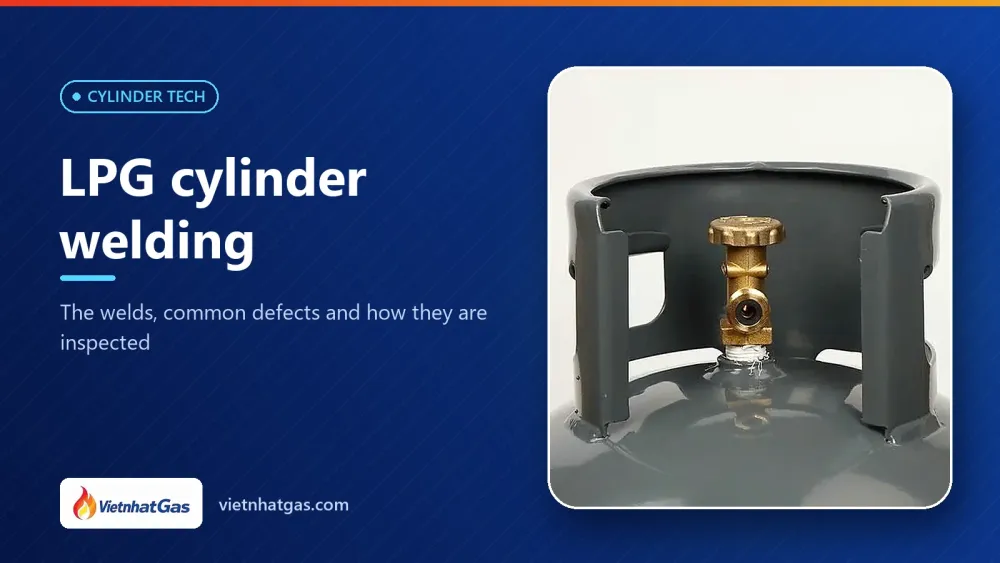
Neck weld: welding the valve boss into the top head, where the valve is fitted.
Attachment welds: the handle guard and foot ring — not directly under pressure, but they must be secure and must not damage the cylinder body.
The three-piece design, with both a longitudinal seam and circumferential seams, is used across many capacities, from the 12kg LPG cylinder to the 45kg LPG cylinder.
Automatic welding technology
Manual welding struggles to keep quality consistent when welding gas cylinders in large volumes. VietnhatGas uses automatic welding lines with two main technologies:
Submerged arc welding (SAW): the arc burns under a layer of flux, giving deep, even penetration with little spatter; usually used for long seams such as the longitudinal and circumferential seams.
MIG welding: welding under a shielding gas, flexible for short welds such as the neck and attachments.
Welding parameters are set and controlled according to the welding procedure. Weld quality also depends on the material — see LPG cylinder steel.
Common weld defects
Porosity: gas bubbles trapped in the weld metal, usually caused by a dirty or damp surface or insufficient shielding gas.
Slag inclusions: welding slag trapped inside the weld, reducing the load-bearing cross-section.
Lack of fusion, lack of penetration: the weld metal does not fully bond with the base metal or does not penetrate the full thickness of the steel.
Cracks: the most dangerous defect, which can grow gradually as the cylinder is repeatedly put under pressure.
Shape defects: undercut, edge misalignment.
How are welds inspected?
Visual inspection: examining the entire weld to detect surface cracks, porosity, undercut and misalignment.
Non-destructive testing: ultrasonic testing (UT) or industrial X-ray to the extent and requirements of the applicable standard, to detect internal defects invisible to the naked eye.
Hydrostatic pressure test: pumping water up to the test pressure and checking for leaks and deformation — see LPG cylinder pressure testing.
Leak test: checking for leaks with gas after finishing.
Welding creates residual stress in the metal, especially in the neck area — where the valve boss is welded and which takes load every time the valve is fitted or removed. Under the VietnhatGas process, the neck area is stress-relief heat treated at around 600 – 650°C, which reduces residual stress and limits the risk of later cracking. After heat treatment and inspection, the cylinder surface is cleaned and then powder coated.
Frequently asked questions
Are the welds the weak point of a gas cylinder?
Compliant welds are made to meet the strength requirements of the whole cylinder. A weld only becomes a weak point when it has a defect that goes undetected, which is why non-destructive testing and pressure testing are steps that cannot be skipped.
Can users check the welds themselves?
Users can only look at the outside: if a weld is cracked, deeply rusted or dented, or you smell gas around a weld, stop using the cylinder and inform your dealer. Assessing weld quality is the job of the manufacturer and the inspection body.
Can a cylinder dented right on a weld be repaired?
Do not try to repair it yourself. A cylinder dented on a weld must be assessed by an inspection body; if it fails, it will be scrapped in accordance with current regulations.
Written by the VietnhatGas technical and sales team — a batch manufacturer of LPG cylinders. This content is for reference; regulations and standards may change, so please check the current texts.
LPG cylinder steel must withstand pressure, weld well, be ductile enough for deep drawing and tough against impacts. Learn how to check CO/CQ, thickness, mechanical properties, chemical composition and the risks of poor steel.
How dealers can manage circulating LPG cylinders: record serial numbers, track cylinders held by customers, reduce losses, handle other brands’ cylinders and those due for inspection, and plan new cylinder purchases.
The documents that come with a new batch of LPG cylinders, the data stamped on the carry handle (shroud), what to check on delivery and how to file records for the authorities.
Read article →
Need a volume quote?
Send us the capacity, quantity and brand printing requirements — VietnhatGas will reply with a batch quotation.