What does a gas smell like? Why gas has a smell and what to do when you notice it
LPG is almost odourless; the characteristic gas smell comes from an odorant added to warn of leaks. How to tell a passing smell from a dangerous leak, what to do immediately and gas leak alarms.
VietnhatGas · · Updated · 4 min read
Many people wonder what a gas smell actually is, and why it is sometimes only faint when changing a cylinder but at other times overpowering. In fact, LPG has almost no smell; the characteristic smell we know comes from an odorant that is deliberately added to warn of leaks.
Why does gas have a smell?
LPG (liquefied petroleum gas, made up mainly of propane and butane) is almost colourless and odourless in its pure state — see what is LPG. Left as it is, leaking gas would be very hard to detect. That is why a very small amount of odorant, usually a compound from the mercaptan group such as ethyl mercaptan, is added to commercial gas, so that users notice straight away when gas escapes.
Recognising the characteristic smell
The odorant gives gas a pungent, unpleasant smell, often described as like rotten eggs or rotten cabbage. The smell is easy to notice even at low concentrations — that is exactly its purpose. Many canned gases, such as the mini butane gas canister, also contain a similar odorant.
Is a passing smell when changing a cylinder normal?
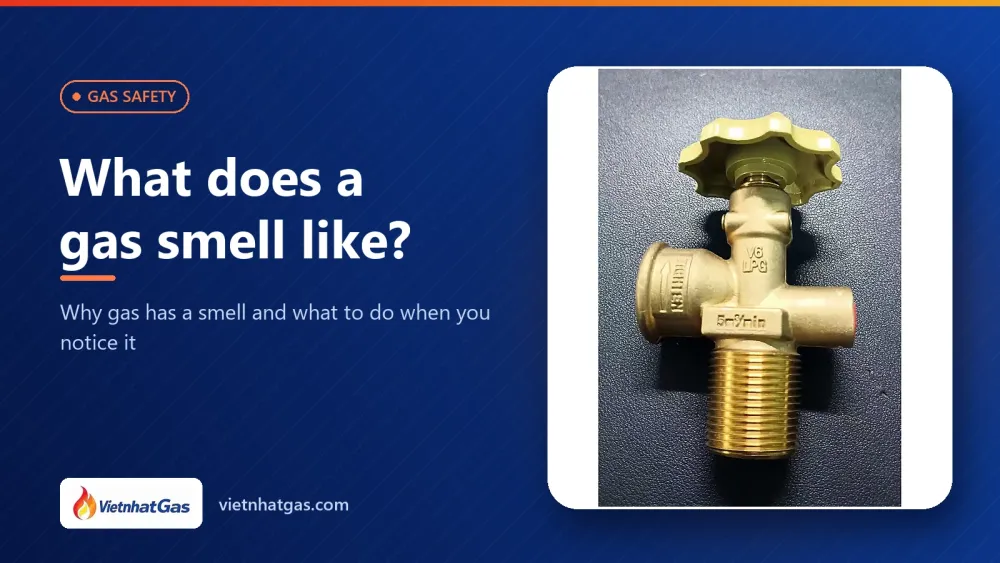
When the regulator is removed and fitted, a very small amount of gas left in the regulator and hose may escape, causing a brief smell. This smell is faint and clears quickly once you open the doors for ventilation. On the other hand, if the smell lingers, gets stronger or appears when nobody is handling the cylinder, it is a sign of a dangerous leak. See how to do it properly in how to change a gas cylinder at home.
What should you do if you smell gas?
The rule is to avoid creating any spark: do not switch electrical appliances on or off, do not light the stove or a lighter, and do not smoke; close the cylinder valve and turn the stove knobs off if you can reach them safely, open doors and windows for natural ventilation, then get everyone out and only call your gas dealer or the fire service on 114 once you are somewhere safe. For the detailed steps and how to find the leak with soapy water, see how to check for gas leaks at home; only use the gas again once the leak has been fixed, and never use a flame to test.
Where leaks often occur
The joint between the cylinder valve and the gas regulator, where the washer has hardened or is missing.
A gas hose that has aged, cracked, been chewed by rats or has a loose clamp.
A stove knob left slightly open, or a flame blown out by the wind or put out by a boil-over while gas is still flowing.
A damaged cylinder or cylinder valve.
Gas leak alarms
A gas leak sensor sounds an alarm when the concentration of gas in the air exceeds a set threshold, which is very useful when the whole household is asleep or nobody is at home. Because LPG is heavier than air, LPG sensors are usually fitted low down, near where the cylinder is kept; install it according to the device manufacturer’s instructions. Combine this with choosing the right place for the gas cylinder to reduce the risk.
What should people with a poor sense of smell bear in mind?
Elderly people, people with a cold or a blocked nose, long-term smokers and anyone with a reduced sense of smell may not notice a leak in time. In these households, it is advisable to fit a gas leak alarm, close the cylinder valve after each time you cook and ask someone else to check regularly.
Frequently asked questions
Is the gas smell toxic?
The odorant is only added in very small amounts. The main dangers of leaking gas are fire and explosion, and suffocation when gas displaces the air in an enclosed space. If you smell it, deal with it at once; do not wait to see whether it goes away by itself.
Why can I still smell gas after closing the cylinder valve?
It may be gas that escaped earlier, which will gradually clear with ventilation. If the smell lingers or gets stronger, the leak may be at the cylinder valve itself or somewhere else — leave the area and call your dealer to check.
What if I smell something like gas but cannot find a leak?
The smell may come from drains, rubbish or the house next door. Even so, ventilate the room, close the valve and ask your dealer to check so the risk can be ruled out.
VietnhatGas manufactures LPG cylinder valves, LPG cylinders and mini butane gas canisters for dealers and distributors. Send a request on our quotation page.
Written by the VietnhatGas technical and sales team — a batch manufacturer of LPG cylinders. This content is for reference; regulations and standards may change, so please check the current texts.
Practical tips on gas dealer customer retention: fast delivery, reminders before the gas runs out, free safety checks, transparent prices, loyalty schemes, looking after restaurants and keeping customer records.
A guide to what to do in a gas fire: stay calm, close the cylinder valve if it is safe, put out a small fire correctly, when to evacuate and call 114 immediately, what to do afterwards and how to prevent it.
A gas leak detector helps detect a build-up of gas early. The common types, why it must be installed low near the floor for LPG, how to test and maintain it, and what to do when it goes off.
Read article →
Need a volume quote?
Send us the capacity, quantity and brand printing requirements — VietnhatGas will reply with a batch quotation.