What to do in a gas fire: steps to take at once to protect people and property
A guide to what to do in a gas fire: stay calm, close the cylinder valve if it is safe, put out a small fire correctly, when to evacuate and call 114 immediately, what to do afterwards and how to prevent it.
VietnhatGas · · 4 min read
A flame flaring up at a cylinder valve or a pan of oil catching fire on the stove can make anyone panic. Knowing what to do in a gas fire helps you react correctly in the first few seconds — and, just as importantly, to know when to stop, get out and call the fire service. The overriding principle: human life always matters more than property.
Step 1: Stay calm and quickly assess the fire
Quickly work out where the fire is, whether it is still small or spreading, whether flames are reaching the gas cylinder and whether your escape route is clear. If the fire is large, spreading or the gas cylinder is surrounded by flames, go straight to Step 4.
Step 2: Cut off the gas supply if it is safe to do so
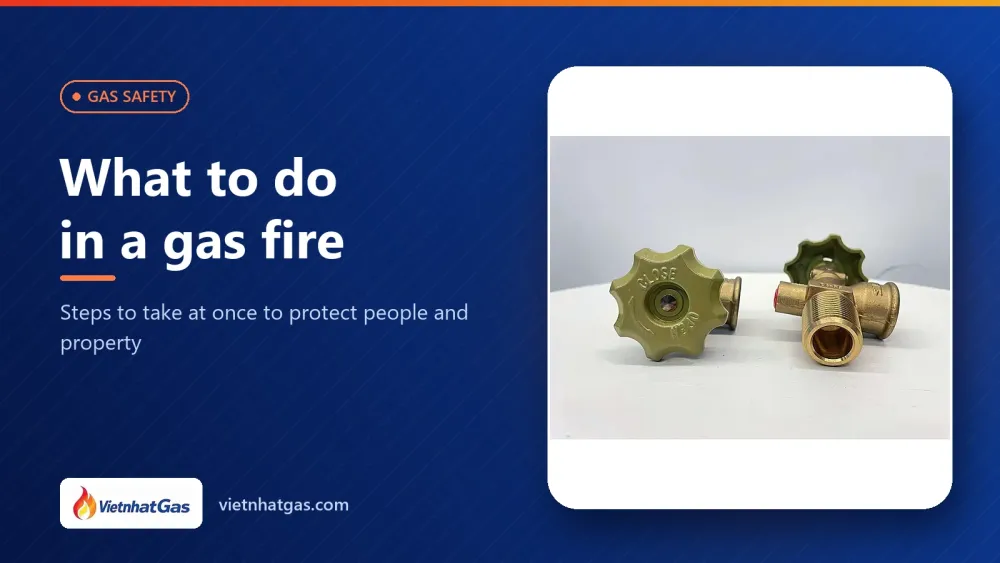
For a small flame at the cylinder valve, regulator or hose, the most effective action is usually to close the cylinder valve: once the gas stops flowing, the flame usually goes out by itself.
Only do this if you can reach the valve without putting any part of your body through the flames.
Wrap your hand in a thick wet cloth and approach from the side without flames.
If the flame is put out but the gas has not been shut off, gas keeps escaping, builds up and may flare up again. If you cannot close the valve, leave the area and call 114.
Step 3: Put out a small fire correctly
A pan of oil on fire: turn off the stove and cover the pan completely with a metal lid, a fire blanket or a well wrung-out wet cloth; do not lift the pan away, and leave it to cool completely.
Small items that have caught fire: cover them with a fire blanket or use a fire extinguisher.
Using a fire extinguisher: pull the pin, aim the nozzle at the base of the fire, squeeze the lever and sweep from side to side. Choose the right type — see kitchen fire extinguishers.
Never pour water onto burning oil: the water turns to steam instantly, throwing the burning oil out, making the flames flare up and causing serious burns.
Step 4: A large fire — evacuate and call 114
Stop all attempts to fight the fire and leave immediately if the fire spreads to kitchen cabinets, curtains or the ceiling; the gas cylinder is surrounded by flames or is being heated; there is thick smoke and it is hard to breathe; or you have used up your firefighting equipment and the fire is still not out.
Raise the alarm and get children and older people out first.
Close the door of the room on fire as you leave, if you can do so quickly.
Keep low when moving through smoke; do not use the lift.
Get outside, keep well away and call 114 immediately; give your address clearly and say that there is a gas cylinder in the fire.
Do not go back in for belongings.
Do not try to move a gas cylinder that is on fire or being heated, and do not stand close by to throw water on it — leave it to the fire service.
After the fire is out
Do not reuse a gas cylinder, valve or hose that has been exposed to flames, even if it looks normal.
Open doors for ventilation; do not switch on electrical equipment if you can still smell gas.
Call your gas dealer to collect the cylinder and check the system. A scorched cylinder must be assessed by an inspection body — see can you use a rusty or dented gas cylinder.
Recharge or replace any fire extinguisher that has been used.
Prevention, so you never have to deal with a gas fire
Never leave the stove while frying; check for leaks regularly with soapy water, never with a flame — see how to check for gas leaks at home; keep the cylinder upright, in a well-ventilated place, away from heat sources; fit a gas leak detector, keep a fire blanket and a fire extinguisher, and have the whole family practise the steps above.
Can a flame at the gas cylinder valve cause an explosion?
A small flame at the valve is usually leaking gas burning at the valve outlet; if you can close the valve, the flame usually goes out. The danger rises sharply when a prolonged flame heats the body of the cylinder — at that point you must evacuate and call 114. See also can a gas cylinder explode.
Should a wet sack be used to put out a gas fire?
Wet cloths or sacks can be used to wrap your hand when closing the valve or to cover a small fire. The most important thing is still to cut off the gas supply; if the fire is large, do not try to put it out.
What is the fire service number?
Call 114 — the emergency number for fire prevention and firefighting, rescue and relief.
VietnhatGas manufactures LPG cylinders, pressure testing every cylinder, with inspection records for dealers and filling plants. Send a request on our quotation page or call our hotline on 1900 4656.
Written by the VietnhatGas technical and sales team — a batch manufacturer of LPG cylinders. This content is for reference; regulations and standards may change, so please check the current texts.
Practical tips on gas dealer customer retention: fast delivery, reminders before the gas runs out, free safety checks, transparent prices, loyalty schemes, looking after restaurants and keeping customer records.
How to calculate how many cylinders a gas dealer needs: cylinders at customers’ homes, cylinders in circulation, full-cylinder stock and a reserve; a worked example, the 12kg – 45kg mix, allowing for growth and signs of a shortage.
Gas cylinders in circulation must be re-inspected when they fall due. Who may carry this out, the technical basis, the usual inspection steps and how dealers should plan for it.
Read article →
Need a volume quote?
Send us the capacity, quantity and brand printing requirements — VietnhatGas will reply with a batch quotation.