Gas or charcoal for a grill restaurant? Flavour, cost and safety
Gas and charcoal compared for grill restaurants: flavour, smoke and ventilation, running costs, speed of service, the risks of carbon monoxide and gas leaks, cleanliness, rules in residential areas and hybrid set-ups.
VietnhatGas · · 4 min read
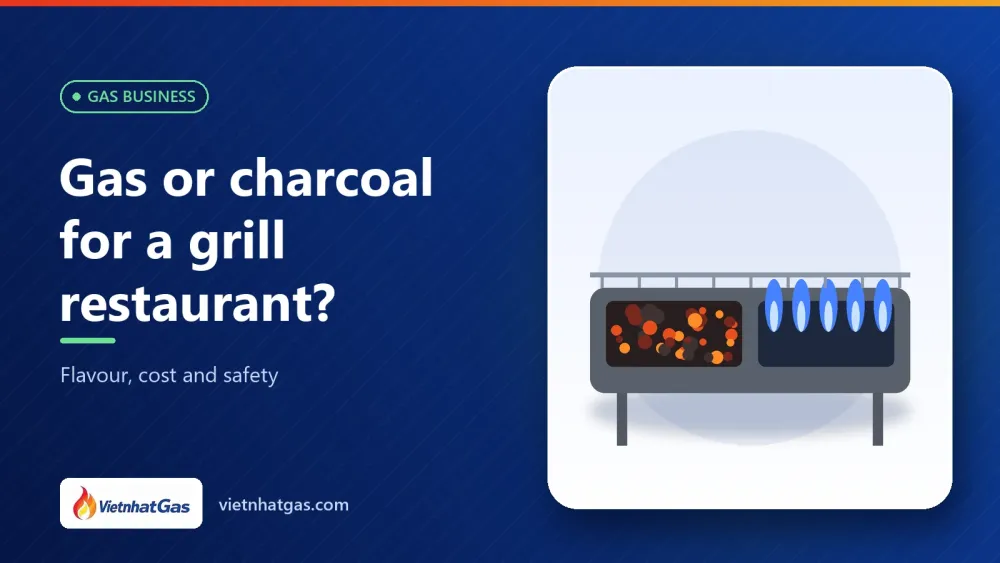
When opening a restaurant, the first question many owners ask is whether to use gas or charcoal for a grill restaurant. Charcoal gives a familiar smoky aroma, while gas is clean and quick; each choice brings a different kitchen layout, ventilation, staffing and safety risks. Below are the criteria to help owners decide.
Flavour: what customers notice first
When grilling over charcoal, fat and marinade drip onto the glowing coals and rise as smoke, giving skewers and grilled ribs their characteristic aroma. Gas stoves give clean heat with little smoke from the fuel; the flavour depends more on the marinade, the type of grill plate or pan and the cook’s skill. In restaurants where customers grill at the table themselves, guests are usually more concerned with meat being cooked evenly and their clothes not smelling of smoke than with a smoky aroma.
Smoke, ventilation and extraction
Charcoal produces a lot of smoke and ash, and needs high-capacity extraction hoods and a flue that discharges away from neighbouring homes. Gas stoves still produce smoke from burning meat fat and still need ventilation, but the extraction system is usually lighter. Restaurants in alleys or in terraced houses sharing walls with neighbours should plan this carefully.
Running costs: compare over a whole shift
Charcoal: has to be lit before opening time and kept burning even when there are few customers, and takes labour to light and to empty the ash.
Gas: turned on when customers arrive and off when they leave, with the flame adjusted for each dish; however, gas prices are adjusted monthly — see why gas prices change every month.
The fairest way to compare is to record fuel costs, labour and cleaning time over a few weeks for each option. To estimate the number of mini gas canisters from the number of tables and customers, use the formula in mini gas for hotpot restaurants.
Speed of service and handling
Gas lights instantly and the flame is adjusted with a knob, so new staff get used to it quickly; at peak times you only need to change a canister or swap in a spare stove. Charcoal needs an experienced person to tend the fire, and it is hard to bring the heat down quickly when meat is about to burn.
Safety: carbon monoxide from charcoal and gas leaks
Charcoal burning where there is not enough air produces carbon monoxide (CO), which is colourless and odourless and can cause poisoning. Do not burn charcoal in closed rooms, air-conditioned rooms with the doors shut or poorly ventilated basements.
With gas, the main risks are leaks and canisters overheating: a grill tray that covers the whole portable gas stove reflects heat down onto the canister compartment. Use a tray that fits the top of the stove or a portable gas stove with a separate canister box such as the VNG/BG003 portable gas stove; dining areas using gas stoves also need ventilation. If you smell gas: turn off the stove, close the valve, do not switch electrical equipment on or off, open the doors to ventilate, take customers outside and call the fire service on 114 from a safe place if necessary.
Cleanliness and rules in residential areas
Charcoal leaves ash and dust, and needs a dry place to store charcoal and a place to dispose of fully cooled ash; gas is tidier but needs a safe place to store canisters and cylinders. Food businesses in residential areas must comply with current regulations on fire prevention and fighting, smoke and dust, and environmental hygiene; ask the authorities where the restaurant is located before investing in stoves.
Combining gas and charcoal
Many restaurants choose a hybrid set-up: portable gas stoves at customers’ tables using 220 – 250g butane mini gas canisters, and a charcoal skewer grill in a well-ventilated outdoor area to keep the characteristic smoky aroma. The back kitchen uses a cast-iron gas wok burner for boiling, frying and pre-grilling. The charcoal area must be kept well away from where gas cylinders and spare canisters are kept; for how to arrange cylinders for the back kitchen, see restaurant gas cylinder installation.
Frequently asked questions
Does grilling on a gas stove make food less flavourful?
There is no charcoal smoke aroma, but a good marinade, an evenly heated grill and the right heat still give tasty food.
Can a charcoal grill be placed near a gas cylinder?
No. Glowing coals, embers and radiated heat are all sources of ignition; gas cylinders and canisters must be kept in a separate, well-ventilated area away from the charcoal grill.
Which option should a small new restaurant choose?
Narrow premises close to neighbouring homes with few staff usually suit gas. If the signature dishes need a smoky aroma and there is open, well-ventilated space, consider charcoal or a hybrid set-up.
The answer to gas or charcoal for a grill restaurant lies in each restaurant’s signature dishes, premises and team. VietnhatGas supplies mini gas canisters, portable gas stoves and wok burners to dealers serving restaurants. Send your requirements on our quotation page.
Written by the VietnhatGas technical and sales team — a batch manufacturer of LPG cylinders. This content is for reference; regulations and standards may change, so please check the current texts.
A rented room is cramped and poorly ventilated: should you choose a portable gas stove, a small gas cylinder or an induction hob? Criteria by room size, landlord rules and cost, safe stove layout and storing spare canisters.
Eight tips for using a portable gas stove: fit the canister correctly, never cover the stove with a large grill plate, use it in a ventilated place, remove the canister after use.
Gel fuel and solid fuel differ in form, how they burn, how the flame is put out and what they suit best. How to choose products with clear labelling, use them safely and store them correctly.
Read article →
Need a volume quote?
Send us the capacity, quantity and brand printing requirements — VietnhatGas will reply with a batch quotation.