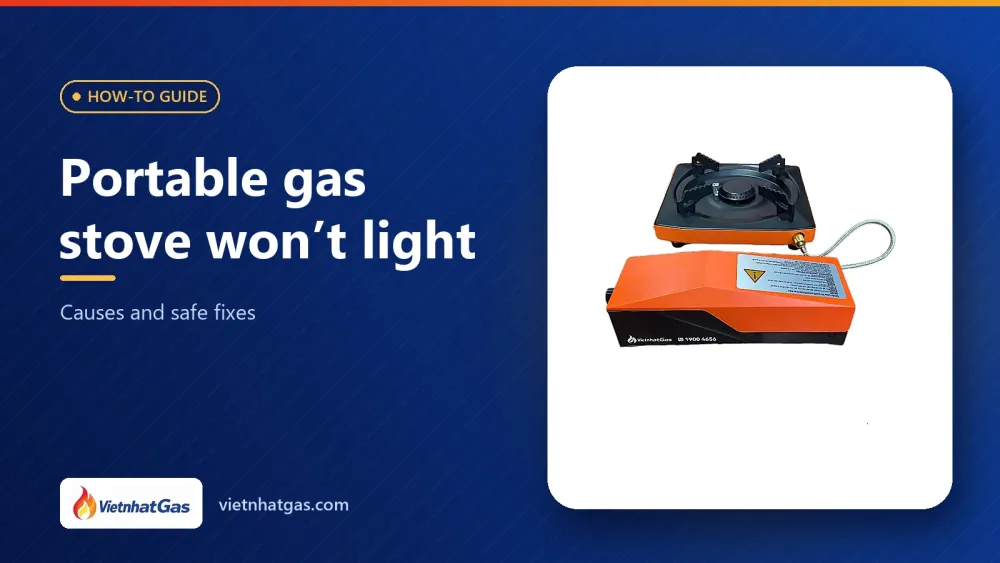
Portable gas stove won’t light: causes and safe fixes
A portable gas stove that won’t light is usually caused by a canister not seated in its notch, an empty or very cold canister, a damp igniter, a blocked burner or a tripped safety valve. Step-by-step checks and when to replace the stove.
VietnhatGas · · Updated · 4 min read
Turning the knob and hearing only a “click-click” with no flame is a very familiar situation. When a portable gas stove won’t light, it is mostly down to simple faults such as a canister fitted incorrectly, an empty canister or a damp igniter. Below is how to check each cause safely and when to stop using the stove.
Before you check: safety first
Turn the knob to the off position, let the stove cool, move the locking lever to the release position and remove the gas canister.
If you smell gas: do not strike a flame, do not switch electrical equipment on or off, take the gas canister outside and ventilate the area — read more in what gas smells like.
1. Canister not seated in its notch, locking lever not engaged
A butane canister has a locating notch on its neck; when fitting it, the notch must line up with the locating groove on the stove as instructed by the manufacturer. Then move the locking lever to the locked position until the canister is held firmly. If the notch is misaligned, gas will not reach the stove or may leak. Remove the canister and refit it the right way round — do not force it. With a stove that has a separate gas box, also check the hose and the connections between the gas box and the stove.
Butane does not vaporise easily at low temperatures, so a canister kept somewhere cold or used continuously for a long time may give a very weak flame or none at all — find out more in what is butane. Let the canister return to room temperature on its own. Never warm the canister over a flame, never stand it in hot water and never place it next to a hot stove.
3. Igniter damp or faulty
If a faint smell of gas comes from the burner but there is no spark, or the spark is weak, the ignition electrode may be damp, dirty or out of position:
Remove the canister, wipe the electrode and the burner area with a dry cloth and let them dry naturally.
Only light the stove with a long-reach lighter if the stove’s instruction manual allows it. If the manual does not mention it, do not light it by hand yourself; take the stove to the seller or a service centre.
4. Burner blocked
Hotpot broth boiling over, grease and food crumbs can block the flame ports or the nozzle. Once the stove has cooled and the canister has been removed, clean the burner with a soft brush and dry it completely before refitting. Do not poke a metal rod into the nozzle.
5. Pressure-sensing safety valve has tripped
Many portable gas stoves have a safety mechanism: when the pressure in the canister rises because the canister has become hot, the locking lever pops out automatically and cuts off the gas. This is a feature that protects the user, not a fault. Common causes are using a pot or grill plate so large that it covers the canister compartment, or placing two stoves close together.
Turn off the stove and let the stove and canister cool completely.
Fix the cause of the overheating before using it again.
Never wedge, tie or tamper with the safety mechanism to disable it.
6. Damaged rubber seal
The seal where the gas canister connects keeps the joint airtight. A seal that is cracked, hardened or deformed lets gas escape, often with a smell of gas or a hissing sound. In this case stop using the stove immediately and do not replace the seal yourself with one of unknown origin.
When should you stop using it and replace the stove?
There is a smell of gas or a hissing sound where the canister fits, even though it is fitted correctly.
The locking lever is loose and does not hold the canister; the stove body is dented, warped or scorched.
The safety valve trips repeatedly even though the stove is used correctly.
You have gone through the steps above and the stove still won’t light.
If the stove is still under warranty, take it with its warranty card to the place of purchase, or call the warranty hotline printed on the card. See also how to use a portable gas stove safely.
Before taking the stove in for warranty repair, check that the canister is seated in the correct notch and actually suits the stove; our guide on how to fit a mini gas canister into a stove shows how to match canister and stove, how to engage the locking lever and the signs of a poor fit.
Frequently asked questions
Why does my portable gas stove click but not light?
There is a spark but no gas: usually the canister is not seated in its notch, the locking lever is not engaged, the canister is empty or too cold, or the safety valve has tripped.
Can I use another brand’s butane canisters with my stove?
Use canisters with a compatible connector as recommended by the stove manufacturer; a canister that does not fit properly can easily leak.
What should I do if my portable gas stove won’t light after washing?
The ignition electrode and burner may still be wet. Let the stove dry completely before trying again; do not dry it with a flame.
Written by the VietnhatGas technical and sales team — a batch manufacturer of LPG cylinders. This content is for reference; regulations and standards may change, so please check the current texts.
A step-by-step guide to cleaning a portable gas stove: remove the canister and let it cool, wipe it daily, clean the pot supports and drip tray, clear the burner ports, check the seal, spot damage and store the stove.
Eight tips for using a portable gas stove: fit the canister correctly, never cover the stove with a large grill plate, use it in a ventilated place, remove the canister after use.
A rented room is cramped and poorly ventilated: should you choose a portable gas stove, a small gas cylinder or an induction hob? Criteria by room size, landlord rules and cost, safe stove layout and storing spare canisters.
Read article →
Need a volume quote?
Send us the capacity, quantity and brand printing requirements — VietnhatGas will reply with a batch quotation.