Butane for hotpot restaurants: working out stoves, canisters and reserve stock
A guide for hotpot restaurant owners to work out the number of stoves per table, estimate daily mini gas canister use, set a safe stock level and ordering rhythm, change canisters mid-shift and set routines for staff.
VietnhatGas · · 4 min read
Running out of gas at peak time keeps guests waiting, while storing too many canisters ties up cash and storage space. This article helps owners work out butane for hotpot restaurants: the number of stoves, canisters per day, stock levels and how to change canisters safely mid-shift.
How many stoves for how many tables?
One stove per table; long tables for large groups may need two pots.
A few spare stoves with canisters already fitted, to swap in immediately for tables that are eating.
Canisters/day ≈ number of tables × sittings per table × hours of cooking per sitting × average gas consumption (g/hour) ÷ gas weight per canister (g)
Sittings: take them from your sales records.
Hours of cooking: record them for a few days to get an average.
Average gas consumption: hotpot is mostly cooked on a medium or low flame, so it is lower than the full-flame figure stated on the stove. For how to read the specifications, see how long a mini gas canister lasts; the most accurate method is to weigh a canister before and after a sitting.
Gas weight per canister: printed on the can body.
An illustrative example with assumed figures: a restaurant with 12 tables, 3 sittings per table, 1 hour of cooking per sitting, a stove using an average of 120 g/hour and canisters holding 250g of gas. That gives 12 × 3 × 1 × 120 = 4,320g, divided by 250g ≈ 17.3 — rounded up to 18 canisters a day. After a few weeks, replace the assumed figures with the actual count of empty canisters.
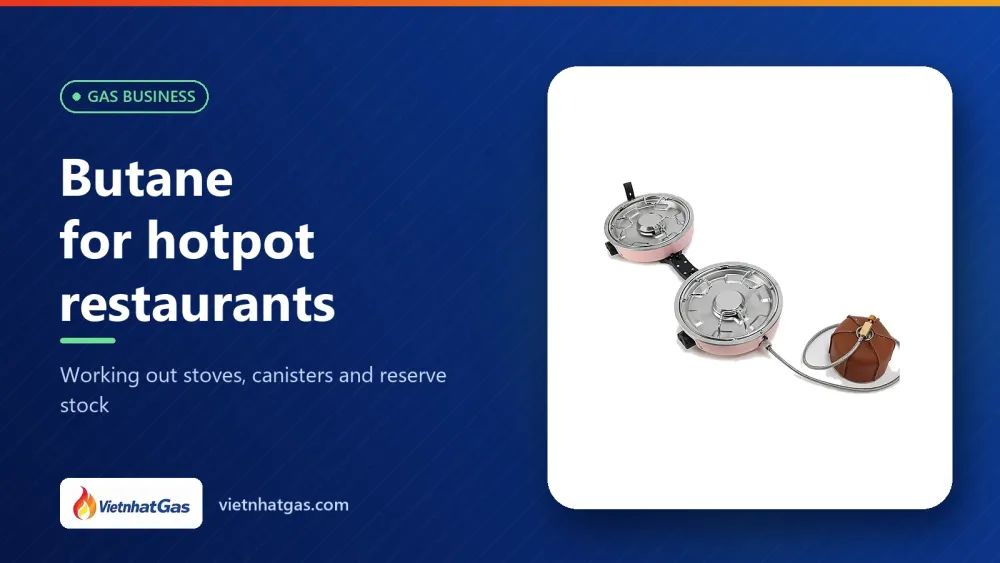
With a canister box stove, the canister sits in its own box, making it easier for staff to check and change canisters each shift.
Safe stock level and ordering rhythm
Reorder level = canisters used per day × days waiting for delivery + a buffer for busy days
Continuing the example above: 18 canisters/day, the supplier delivers after 2 days, and a weekend day uses about 27 canisters. Reorder level ≈ 18 × 2 + 27 = 63 canisters, converted into cartons according to the supplier’s packing specification.
Order on a fixed rhythm, for example once or twice a week.
Increase quantities before the cold season and Tết holidays — seasonal patterns are covered in our article on the mini gas canister business.
Turn the stove knob off, swap in a spare stove for the table and take the old stove out of the guest area.
Change the canister in a separate, well-ventilated corner, away from lit stoves and the reserve canister cartons; wait for the stove to cool before removing the canister.
Check that the new canister is not dented and still has its cap; fit it into the correct notch, and listen and smell for any gas escaping.
If a canister still has gas, cap it, mark it and use it first for the next sitting; collect empty canisters separately, and do not puncture or burn them.
Do not change canisters on guests’ tables, and do not keep reserve canisters under tables.
Routines for staff
Start of shift: count canisters in stock and check the seal and locking lever of each stove.
During the shift: assign one person per table area to change canisters.
End of shift: remove all canisters from the stoves, count the empty canisters and record them to fine-tune the formula; clean the stoves following our guide to cleaning a portable gas stove.
If you smell gas: turn the stove off, remove the canister, ventilate and do not switch electrical equipment on or off.
Buying butane for hotpot restaurants in batches
Agree with your supplier on regular order quantities, delivery schedules, exchange of faulty canisters and documents for each batch. Using one type of canister compatible with your stoves, such as 220 – 250g butane mini gas canisters, keeps calculations and canister changes consistent.
Frequently asked questions
How many mini gas canisters does one hotpot table use?
It depends on the stove, flame level, pot size and how long guests stay; weigh canisters before and after a few sittings to get your own restaurant’s figures.
Can a canister removed because of a weak flame be used again?
Usually, yes. A weak flame may be because the canister has cooled during long cooking; let it return to room temperature and use it for a short sitting. Do not heat the canister.
Should a small restaurant stock lots of canisters just to be safe?
This is not advisable. Only stock what you can store safely and agree regular deliveries with your supplier.
VietnhatGas supplies butane mini gas canisters by the carton and portable gas stoves for hotpot restaurants. Send us your number of tables and expected usage on our quotation page.
Written by the VietnhatGas technical and sales team — a batch manufacturer of LPG cylinders. This content is for reference; regulations and standards may change, so please check the current texts.
Butane canisters for portable stoves are designed for single use. Why decanting gas yourself or using a refill service is very dangerous, what to do with empty canisters and why you should buy new ones from a reliable source.
How to spot low-quality butane canisters by the label, batch code, can body, valve and price; why caution is needed and which documents dealers should request from their suppliers.
Butane canisters contain liquefied gas under pressure, so they need to be kept in the right place. A guide to choosing where to keep them at home, stacking cartons and managing canisters in shops and warehouses, and regular checks for safe use.
Read article →
Need a volume quote?
Send us the capacity, quantity and brand printing requirements — VietnhatGas will reply with a batch quotation.