Frozen gas cylinder: why does it sweat and frost over, and what should you do?
Why gas cylinders sweat and frost over during long cooking, what the frost line tells you, how to deal with it properly, what you must never do and when ice is a sign of a gas leak.
VietnhatGas · · 4 min read
After a strong flame has been running continuously for a while, the outside of the gas cylinder starts to collect water as if it were sweating, then becomes covered in a layer of white frost. A frozen gas cylinder makes many people worry that it is about to fail. In fact this is a physical consequence of the gas vaporising, but it signals that gas is being drawn from the cylinder faster than it can cope with — and there is one case that must be told apart, because it is a sign of a gas leak.
Why does a gas cylinder sweat and then frost over?
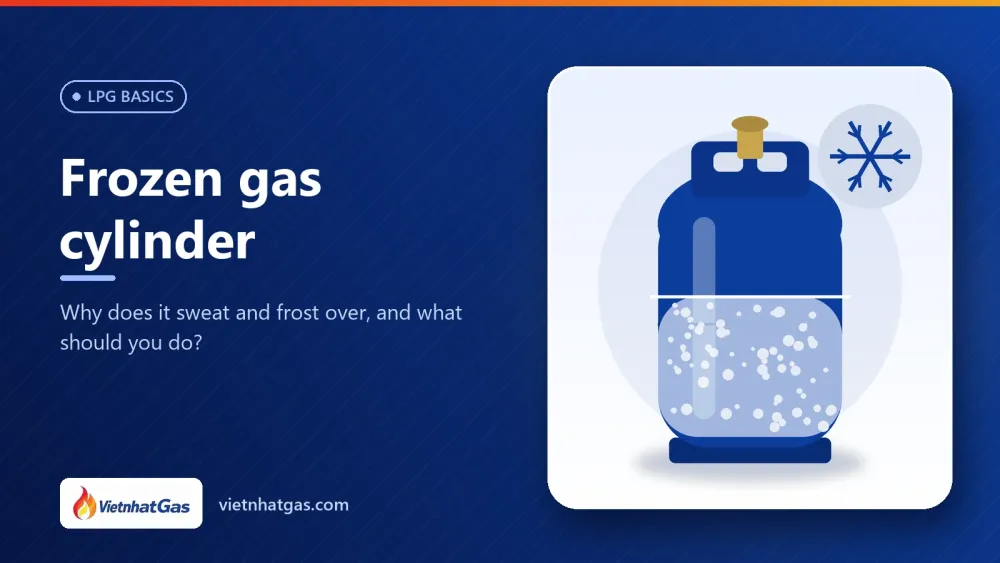
Inside the cylinder, the gas is mostly liquid; the stove uses only the vapour above it. Whenever vapour leaves, some of the liquid vaporises to replace it, and this process draws heat from the liquid gas, the steel wall and the surrounding air. When gas is drawn moderately, heat from the surroundings makes up for it in time; when a lot is drawn continuously, the liquid gas gradually cools, and the cylinder wall with it. When the cylinder is colder than the air, water vapour condenses into droplets — the cylinder “sweats”; when it falls below freezing point, the condensed water turns into white frost.
This tends to happen when a large burner runs for a long time, several burners share one cylinder, the weather is cold or the cylinder is running low.
What does the frost line tell you?
The frost usually covers only the lower part of the cylinder and stops at a fairly clear horizontal line, because the gas vaporises in the part holding the liquid gas, so that part of the wall is the coldest. The frost line therefore gives a rough idea of how much liquid gas remains; to know exactly, you still have to weigh the cylinder.
What does a frozen cylinder indicate?
The colder the liquid gas, the lower its vapour pressure, so the stove receives less gas and the flame gradually weakens even though the cylinder still holds plenty of gas. This is a sign that the amount of gas being drawn exceeds the cylinder’s ability to vaporise it. For other causes of a weak flame, see weak or red gas stove flame.
How to deal with it properly
Reduce the load temporarily: turn the flame down or run fewer burners at once so that the cylinder warms up naturally.
Use a larger cylinder: a 45kg cylinder has a larger surface area than a 12kg cylinder, so it delivers vapour more steadily to high-output burners such as a cast-iron gas wok burner.
Alternate between two cylinders: close the valve on the frozen cylinder and use the other one so that the first can warm up on its own; the connections should be made by a dealer or a qualified technician.
Place the cylinder in a well-ventilated spot, not shut away in a closed cabinet, so that air can circulate around it.
Keep the base of the cylinder dry: melted frost collecting at the bottom over time makes the foot ring rust.
Never heat the cylinder
Do not apply a flame or a blowtorch to the cylinder, do not place it next to a heater or a charcoal stove, and do not pour hot water over it or stand it in hot water. Local heating makes the pressure inside the cylinder rise quickly; beyond the limit, the safety valve on the cylinder (if fitted) may release gas right next to the heat source. When the cylinder is cold, the safe approach is to reduce the load or increase the number of cylinders.
Telling it apart from ice at the valve or joints
Frost evenly covering the lower part of the cylinder during cooking is normal vaporisation. The worrying case is when frost or ice appears only at the valve neck, the regulator, the end of the hose or a joint, especially with a hissing sound or a smell of gas: gas escaping through a gap expands rapidly and cools the leak point. In that case:
Do not switch electrical equipment on or off, and do not create any flame.
Close the cylinder valve if you can reach it safely; open doors and windows for natural ventilation.
Leave the area and only call your gas dealer once you are outside; if the smell is strong or there are signs of fire, call the fire service on 114.
The phenomenon itself is not dangerous, as long as there is no smell of gas and the frost is not concentrated at a joint.
Why do household cylinders rarely frost over?
Household stoves use little gas and do not run continuously for hours, so heat from the air is enough to make up for it. If a household cylinder frosts over during normal cooking, ask your dealer to check the valve and joints.
Does a frozen gas cylinder mean it is about to run out of gas?
Not necessarily. A cylinder with plenty of gas can still freeze when too much is drawn from it; to know how much gas is left, weigh the cylinder.
VietnhatGas manufactures 12kg and 45kg gas cylinders and gas wok burners for dealers serving eateries, restaurants and canteens with high-output cooking needs. Send a request on our quotation page.
Written by the VietnhatGas technical and sales team — a batch manufacturer of LPG cylinders. This content is for reference; regulations and standards may change, so please check the current texts.
Retail LPG prices are usually adjusted every month, mainly in line with world CP prices, along with exchange rates, freight, distribution costs and taxes and fees. The difference between the gas price and the cylinder price, and how dealers announce new prices.
Which fire extinguisher or fire blanket should a gas kitchen have? The pros and cons of each type, why never to use water on a burning pan of oil, where to keep it, and how to check it and practise using it.
Is a rusty gas cylinder, or one that is dented, scorched or bulging, safe? How to tell surface rust from serious damage, what users should do and how dealers deal with damaged cylinders.
Read article →
Need a volume quote?
Send us the capacity, quantity and brand printing requirements — VietnhatGas will reply with a batch quotation.