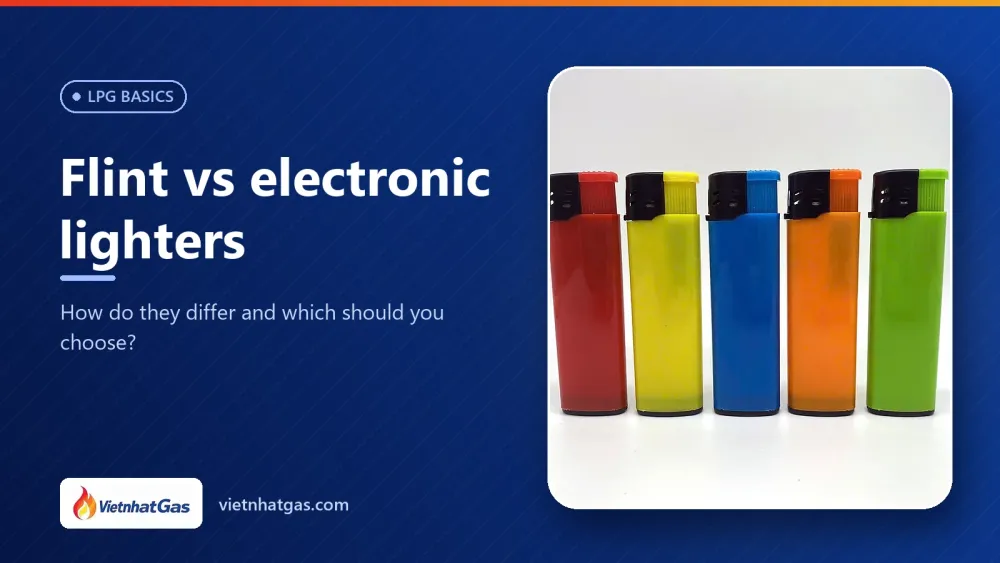
Flint vs electronic lighters: how do they differ and which should you choose?
Flint lighters strike a spark with a wheel and flint, electronic lighters use a piezo igniter. A comparison of how they work, reliability in damp and cold, wearing parts, ease of use and how shops choose what to stock.
VietnhatGas · · 3 min read
Both run on butane and both give the familiar yellow flame, but with flint vs electronic lighters, the spark is created in two different ways. That difference determines durability, how they behave in damp weather and which type suits which group of customers.
How does a flint lighter work?
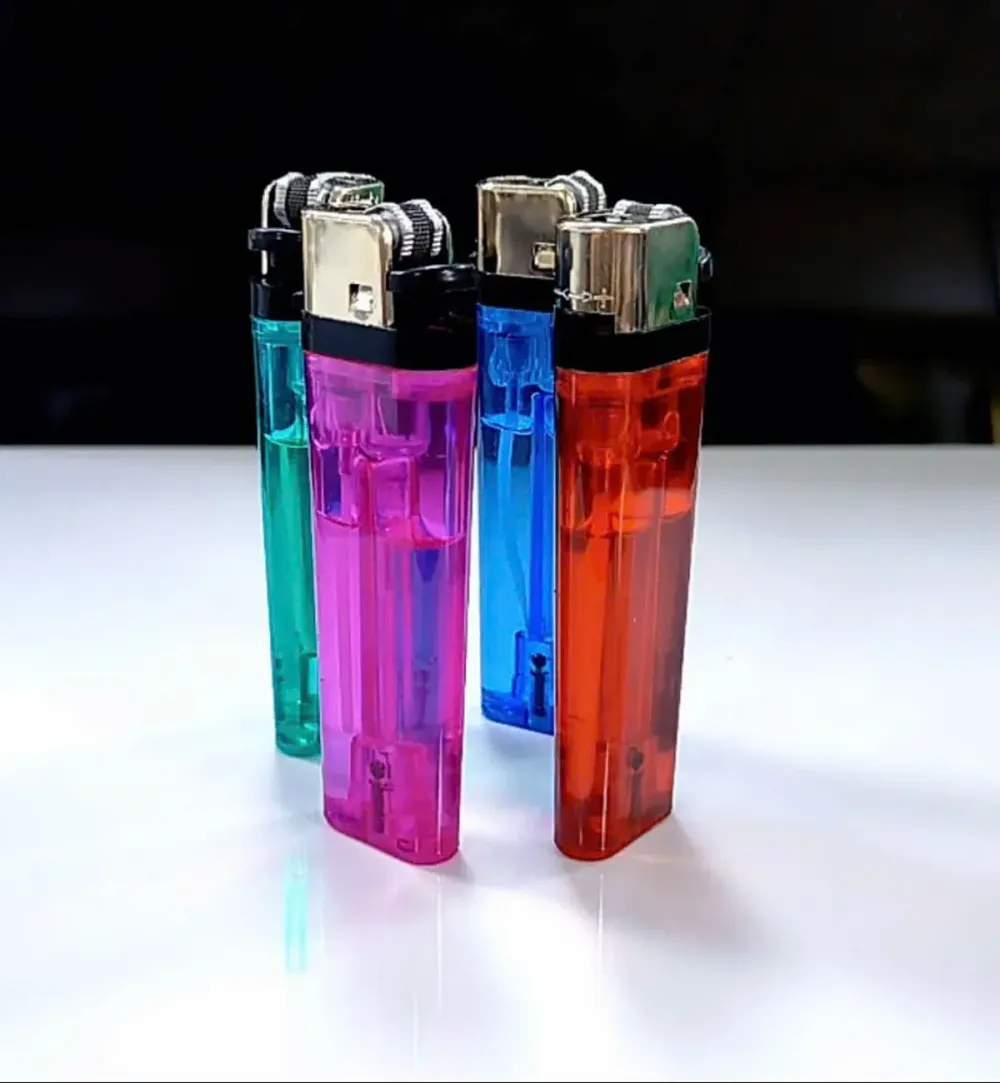
The head of a flint lighter has a serrated metal wheel pressing against a flint — a small alloy rod pushed up from below by a spring. The thumb rolls the wheel, which scrapes the flint to produce a shower of sparks; straight afterwards, pressing the gas lever opens the valve, and the gas meets the sparks and ignites.
Limitations: requires thumb strength and the right “roll then press” action; the flint gradually wears down with each strike.
How does an electronic lighter work?
An electronic lighter, also called a magneto lighter, uses a piezoelectric igniter. When the button is pressed, a small spring-loaded hammer strikes a piezoelectric crystal, generating a momentary high voltage and an electric spark at the lighter head; the same press opens the gas valve. This mechanism needs no battery and usually gives a characteristic “click”. USB-rechargeable arc lighters are a different type and do not use gas.
Advantages: lights with a single press, needs little effort, no flint to replace.
Limitations: the piezo igniter may fail after a hard drop or after a very large number of presses; a misaligned or dirty electrode makes it hard to light.
A flint lighter is easy to recognise by the serrated wheel on the metal hood at the top.
Reliability in damp, cold and windy conditions
When damp: a wet wheel and flint give weak sparks; drying them and rolling the wheel a few times usually gets it working again. If water gets into the igniter of an electronic lighter, you must wait until it is completely dry, and sometimes it does not recover.
When cold: both are affected, because butane vaporises poorly at low temperatures — see what butane gas is. Keep the lighter warm in a pocket; do not hold it over a flame.
When windy: both give a soft flame that blows out easily; for a windproof flame choose a torch type — see what a torch lighter is used for.
Wearing parts and service life
On a flint lighter, the flint and wheel are the parts that wear; a wheel worn smooth will slip and give sparse sparks. On an electronic lighter, the piezo igniter and electrode are the weak points. Disposable plastic lighters cannot have their flint replaced or be refilled; for types with a refill valve, follow our guide on how to refill a gas lighter.
Flint vs electronic lighters compared
Criterion
Flint lighter
Electronic lighter
Spark generation
Wheel scrapes the flint
Piezo igniter creates an electric spark
Operation
Roll the wheel, then press the gas lever
Press one button
Parts prone to wear or failure
Flint, wheel
Piezo igniter, electrode
When damp
Usually works again once dried
Must wait until completely dry
Suits
Practised users wanting an affordable option
Older people, those with weak hands, service counters
Which type should shops stock?
Stock both: flint lighters for price-conscious customers, electronic lighters for customers who want easy operation; track which sells better and adjust.
Randomly test a few from each box: sparks reliably, steady flame, no gas smell. For sourcing and display, see our article on the gas lighter business; clear-bodied models such as the VNG/BL-001 let customers see the gas level.
Families with young children: recommend models with a locking mechanism — see child-resistant lighters.
Frequently asked questions
Why does a flint lighter keep failing to light?
Usually because it is out of gas, the flint is worn out, or the wheel is wet or worn smooth. If there are sparks but no flame, check the gas level; if there are no sparks, the flint or wheel is at fault.
Do electronic lighters need batteries?
No. Gas-fuelled electronic lighters create the spark with a piezo igniter and do not use batteries.
Which type is safer?
Safety depends more on the quality of the valve, body and locking mechanism than on the ignition method; choose products of clear origin and keep them out of children’s reach.
VietnhatGas supplies gas lighters to dealers, convenience stores and businesses, including models that can be printed with a logo — see our article on logo-printed gift lighters. Send your request on our quotation page.
Written by the VietnhatGas technical and sales team — a batch manufacturer of LPG cylinders. This content is for reference; regulations and standards may change, so please check the current texts.
How child-resistant lighters work: a firmer press, a lock button, a two-step action. How to use them correctly, why they cannot replace supervision, and how to choose and store them.
Logo-printed gift lighters for restaurants, cafés, dealers and events: why they work, choosing a lighter type, design tips, printing on plastic bodies, quantities, lead times and distribution.
A torch lighter gives a focused flame that the wind rarely blows out. Its uses in the kitchen, for lighting charcoal and when camping; what not to do, the safety lock, refilling and storage.
Read article →
Need a volume quote?
Send us the capacity, quantity and brand printing requirements — VietnhatGas will reply with a batch quotation.